
by Giuseppe Scarlata, Antonino Napoleone, Maria Chiara Rosace | February 5, 2021.
The development and launch of the vaccine campaign have led research to progress at an astonishing speed, both in diagnostics and prophylaxis. The path for a better understanding of the viral infection and replication mechanisms, as well as the evolution of the infection in the human body, is still long. Nevertheless, thanks to the results of scientific research our knowledge has increased considerably over the past year: we know more about the COVID-19 incubation period, which lasts on average 5-7 days (please see: Covid-19 – Asymptomatic cases and incubation period), the clinical picture of the symptomatology is quite clear, as well as the virus transmission methods. However, some questions remain open: what happens once the organism has defeated the virus? Is it possible that some after-effects remain even after its total eradication by our immune system? Unfortunately, the answer is yes, which is why nowadays we often hear about the post-COVID-19 syndrome.
What is the post-COVID-19 syndrome?
It is a pathological state characterised by a complex of symptoms more or less severe and clearly ascribed to the after-effects caused by the SARS-CoV-2 infection. A study published a few months ago by researchers affiliated to the Department of Geriatrics of the Policlinico Universitario Agostino Gemelli IRCCS in Rome in the prestigious journal JAMA, helps us to clarify and outline the characteristics of the post-COVID-19 syndrome. The study was conducted following precise methods of data collection and follow-up of the individuals involved, according to the following protocol:
- a post-acute outpatient service was established for patients discharged from hospital after COVID-19 (and therefore tested negative on molecular testing with RT-PCR);
- patients completed some questionnaires during the acute phase of the disease to monitor the presence or absence of symptoms and their possible disappearance at the time of the follow-up visit;
- finally, patients scored from 0 to 100 their quality of life before the disease and at the time of the outpatient visit.
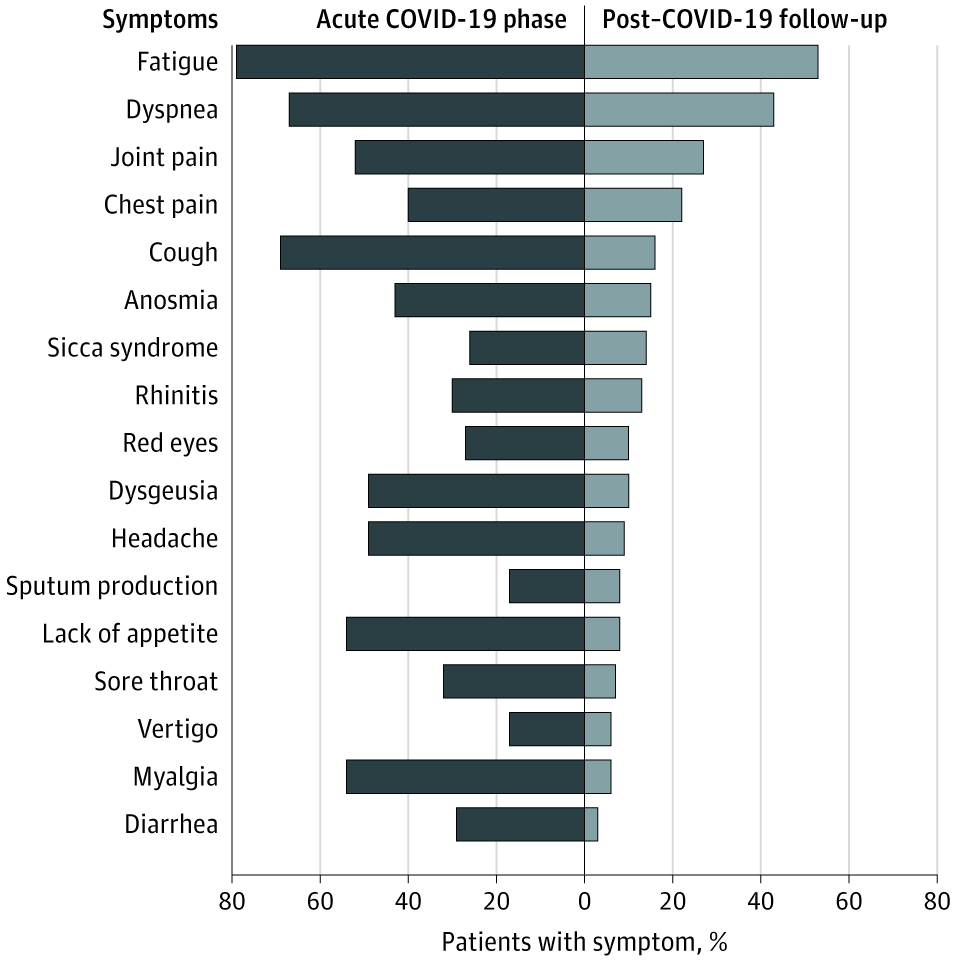
Data were collected from 143 patients (slightly more than half women), on average 57 years old. 72.7% of the 143 patients involved, had evidence of interstitial pneumonia during hospitalisation: 15% of them required non-invasive ventilation while 5% required invasive ventilation throughout the hospitalisation (approximately 14 days). At the time of evaluation, only 12.6% of the patients were asymptomatic, 32% reported one or two symptoms and 55% three or more. The results showed that 44.1% of patients had a worsening of living conditions. Figure 1 shows that a high percentage of individuals reported symptoms such as fatigue (53.1%), dyspnea (43.4%), joint pain (27.3%), and chest pain (21.7%) at the time of the outpatient visit. Overall, 87.4% recovered from Covid-19, reported persistence of at least one disease-related symptom.
And that is not all. Additional studies report other relevant symptoms, including balance problems, cognitive decline, and mental health disorders due to the long stay in intensive care units. This last symptom is not surprising at all. As a matter of fact, even healthy people forced to self-isolation during the lock-down period have experienced mental and psychological disorders (for additional information please visit ” Covid-19 – The risks behind self-isolation: the impact of lockdown on the psyche “). In addition, a considerable percentage of patients reported damage to kidneys, to the respiratory system, and to the cardiovascular system. This damage has been associated with hyperinflammatory responses as a consequence of the cytokine cascade during the pathogenetic process. In the most serious cases, the production of micro-thrombi, embolism and hypoxia phenomena were also observed.
Can post-COVID syndrome also affect an asymptomatic person?
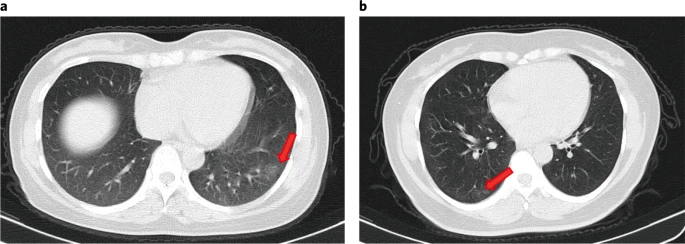
You might expect that as asymptomatic infections are characterised by absence or mild onset of symptoms, there is no post-COVID syndrome for an asymptomatic person. Yet, a study published on Nature Medicine shows that even in such cases abnormalities can be detected through radiological and laboratory examinations. 37 asymptomatic individuals were studied, including 22 females, aged between 8 and 75 years, who tested positive to RT–PCR. To analyse and report the progress of the infection, patients were monitored daily and underwent several tests, including blood tests, coagulation function, liver and renal function, and chest CT (Chest Computed Tomography). The results showed that of the 37 asymptomatic individuals, three had lymphopenia (low levels of lymphocytes), and one had thrombocytopenia (low levels of platelets). Six individuals had elevated levels of alanine aminotransferase (an enzyme which can be mainly found in the liver and kidneys, whose elevated values indicate the presence of damage/disturbance in those organs), and 11 had increased C-reactive protein levels (indicating an ongoing inflammatory process). Chest computed tomography (CT) scans showed focal ground-glass opacities in 11 asymptomatic individuals (focal ground-glass opacities, 29.7%) and stripe shadows and/or diffuse consolidation in ten individuals (stripe shadows, 27.0%), up to the 37 under examination, indicating the presence of an inflammatory process in the affected lung areas (Figure 2). This was further clarified by the higher-than-normal concentration of some pro-inflammatory cytokines/molecules detected on blood tests, indicating the presence of an ongoing inflammatory process, albeit to a markedly reduced extent compared with symptomatic individuals.
Facing a problem that should not be underestimated.
It is clear that even patients that have been discharged from the hospital may be debilitated and their quality of life may be adversely affected, once the infection is over. A better understanding of the post-COVID-19 syndrome is still needed, and new research projects need to be funded, additional studies conducted, and clinical data collected. The problem is not to be underestimated and the only solution at the moment is, once again, prevention: social distancing, wearing masks and using sanitising gels. We share our trust in medical science and not media, remembering that in order to leave behind the pandemic of COVID-19 we need the collaboration of the whole population.
References
- https://www.cdc.gov/coronavirus/2019-ncov/symptoms-testing/symptoms.html
- Carfì A, Bernabei R, Landi F, for the Gemelli Against COVID-19 Post-Acute Care Study Group. Persistent Symptoms in Patients After Acute COVID-19. JAMA. 2020;324(6):603–605. doi:10.1001/jama.2020.12603
- Jaffri A, Jaffri UA. Post-Intensive care syndrome and COVID-19: crisis after a crisis?. Heart Lung. 2020;49(6):883-884. doi:10.1016/j.hrtlng.2020.06.006
- Hanff TC, Mohareb AM, Giri J, Cohen JB, Chirinos JA. Thrombosis in COVID-19. Am J Hematol. 2020 Dec;95(12):1578-1589. doi: 10.1002/ajh.25982. Epub 2020 Sep 16. PMID: 32857878; PMCID: PMC7674272.
- Long Q-X, Tang X-J, Shi Q-L, et al. Clinical and immunological assessment of asymptomatic SARS-CoV-2 infections. Nat Med. 2020;26:1200-1204. doi:10.1038/s41591-020-0965-6
You may also like this

Europe’s top universities: Where research thrives in 2025

Microbes and Mood: Deciphering the Connection for a Happier You!

Can’t solve a maze? Ask a slime mould!

The neurobiology behind the Christmas spirit
