
by Giuseppe Scarlata, Antonino Napoleone, Domenico Gangemi | July 17, 2020
The current pandemic is still the main topic of many debates; it has been discussed for more than seven months and it will probably continue to be discussed. In spite of the various statements taken into account, especially from various and opposing fronts in which politicians, doctors, biologists, but also ordinary citizens have been involved, it continues to be difficult to find a way that can bring public opinion convergent and in line with science. In a continuous and variegated succession of opinions, false news and arbitrarily blame, the top experts of international health have been questioned by the media about the timing and the possibility of distributing a potential vaccine to prevent the pandemic by the end of the year (read more about “The race for the winning vaccine”). A recent article published in the well-known journal The Lancet about the “Prevalence of SARS-CoV-2 in Spain (ENE-COVID): a nationwide, population-based seroepidemiological study” has found complete endorsement by experts like Prof. Roberto Burioni (Professor of Virology and Microbiology at the San Raffaele University of Milan) and Dr. Silvio Brusaferro, president of the Italian Institute of Health (Istituto Superiore di Sanità). Both had no scruples in declaring that it will be necessarily needed the vaccine to have the much-coveted herd immunity.
What is herd immunity?
Herd immunity is a concept originally coined almost a century ago, but it has only found great acceptance in the scientific community in recent decades, especially in conjunction with arguments such as vaccines and all aspects related to prevention (eradication of infectious diseases, cost-benefit analysis of the health system, national vaccination programs).
Herd immunity is therefore an important concept in the management of infectious diseases in relation to the population. The phenomenon can be easily explained as a form of indirect protection from an infectious disease. This protection occurs when a sufficient number of individuals within a population acquire immunity against a pathogen, such that the transmission of the pathogen itself slows down until it is completely reduced. This is because the pathogen will have fewer individuals available to infect because in theory, the more immune individuals there are, the smaller the reservoir of individuals still susceptible to being infected by the pathogen (Figure 1). The effectiveness and possibility of achieving herd immunity largely depend on the strength and duration of the immune response following an infection, the so-called “immune system memory”.
For pathogens in which a long-lasting immune response develops, as is the case of measles, both vaccination and natural recovery provide lifelong immunity, which for instance, does not develop with the influenza virus.
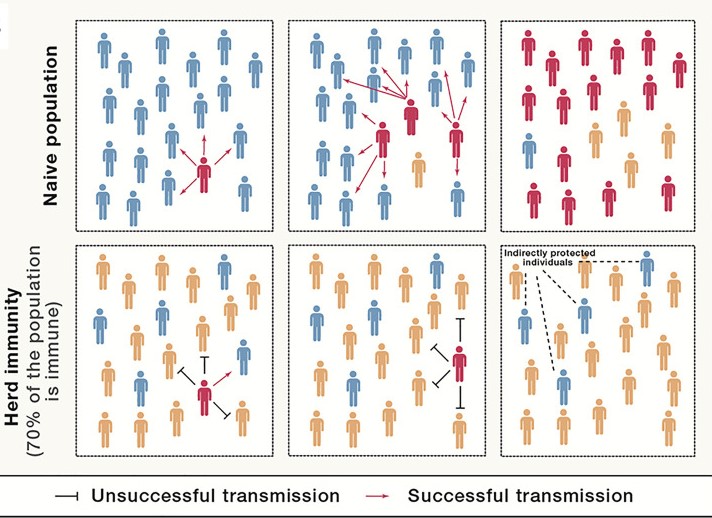
To get immunised, there are essentially two mechanisms:
- Vaccination (which can provide short or long-lasting protection, depending on the type of vaccine and the type of pathogen);
- Natural recovery from the infection with relative production of neutralizing antibodies and memory immune cells (after how long do neutralizing antibodies against SARS-CoV-2 develop?).
In the first case, several projects are under investigation to verify the safety and duration of the protection of an effective vaccine against SARS-CoV-2. Clearly, in the second case, it is not enough to expose those who have already recovered from SARS-CoV-2 (or perhaps even asymptomatic individuals) in order to obtain herd immunity in the majority of the population. This approach, without any other resolutive practice of prevention or individual protection, could run the risk of increasing the spread of the pathogen in an uncontrolled way.
This approach, without any other resolutive practice of prevention or individual protection, could run the risk of increasing the spread of the pathogen in an uncontrolled way. In fact, it has been seen that such choices have caused controversy and have not led to the hoped-for results; glaring examples have been the United States, Brazil, the United Kingdom, and Sweden, whose governments have pioneered the concept of herd immunity through the free circulation of the virus and the recovered among the population, making it their cornerstone in the management of the pandemic in contrast to the rest of international governments. Especially considering that the immune mechanisms behind the COVID-19 infection have not yet been fully clarified by scientists, the consequences are not long in coming: Brazil has had the highest number of daily deaths for days and July 9 has been defined as the “black day” of the United States with over sixty thousand infections in less than 24 hours, demonstrating that the virus without the necessary precautionary measures does not slow down, on the contrary, it is out of control.
The new study published on The Lancet
The researches carried out by the team of Prof. Marina Pollàn brought to a survey on the seroprevalence of the Spanish population, meaning by seroprevalence the number of people who, having already contracted the infection, have specific antibodies in their blood. Such investigations are not new in the world of microbiology and epidemiology and they are of fundamental importance. In the study, several families were selected using randomized sampling. In the period between 27 April and 11 May 2020, 61075 (75% of all individuals contacted within the selected families) responded to a questionnaire on possible risk factors and symptoms related to Coronavirus Infectious Disease 19 (COVID-19), then agreeing to undergo specific serological tests such as the rapid finger-prick immuno-chromatography (ICG) test and a blood sample for the antibody detection of Immunoglobulin G (IgG) by chemiluminescence (CLIA) [read more about serological tests]. The calculated seroprevalence was only 5% for the rapid test and 4.6% for the chemiluminescence test. Clearly, given the increased exposure to the pathogen of the at-risk population, seroprevalence increased with age, and health care workers were the category with the highest IgG antibodies against SARS-CoV-2. One-third of the seropositive participants were asymptomatic, ranging from 21.9% to 35.8%, while only 19.5% of the seropositive symptomatic participants in both tests reported a history of molecular testing using Real-Time Polymerase Chain Reaction (RT-PCR). In addition, the geographical variability was significant and showed a higher prevalence around Madrid (<10%) (Figure 2).
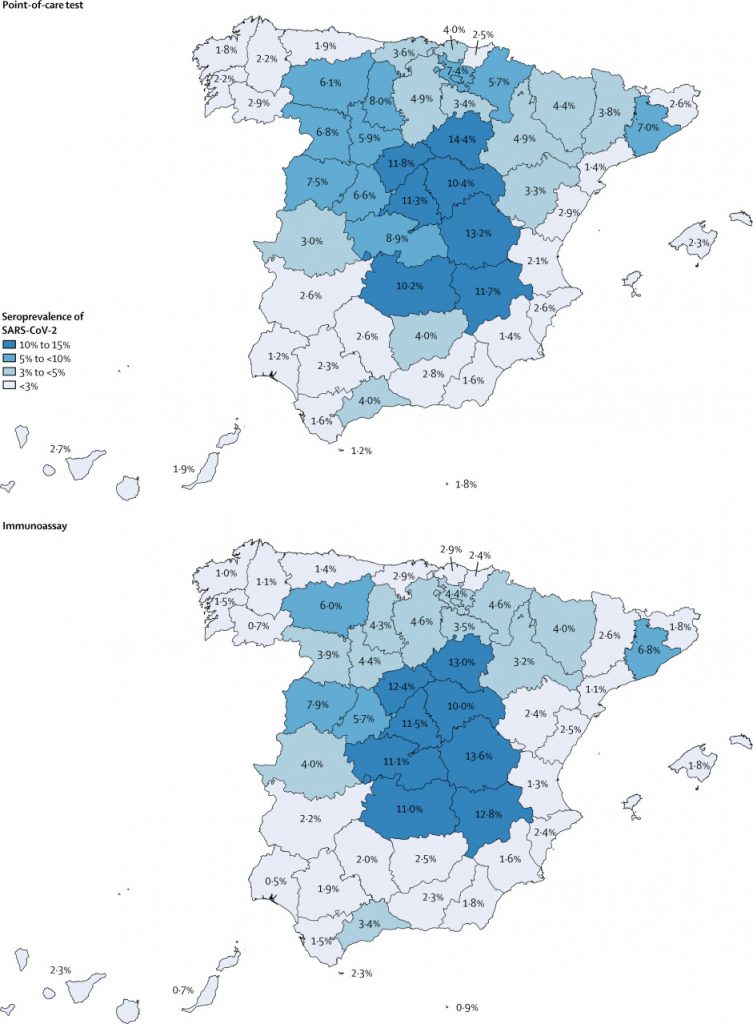
Figure 2: Seroprevalence of SARS-CoV-2 by province by the point-of-care test and immunoassay.
This study, therefore, puts a brake on the possibility of reaching the herd immunity without an adequate vaccine, stating that, although the impact of the disease in Spain is high, seroprevalence is so low that it cannot guarantee herd immunity. The risk of thinking the opposite would, once again, be the overloading of health care systems. The results of this study show that, once again, social distancing, contact tracing via apps, and general common sense would remain the only viable avenues while awaiting an effective vaccine. Share and have faith in medical sciences rather than the media, we all need to work together to stem the pandemic and its consequences.
References:
- John, T. J., & Samuel, R. (2000). Herd immunity and herd effect: New insights and definitions. European Journal of Epidemiology, 16(7), 601–606. https://doi.org/10.1023/A:1007626510002
- Fine, P., Eames, K., & Heymann, D. L. (2011). “Herd immunity”: A rough guide. Clinical Infectious Diseases, 52(7), 911–916. https://doi.org/10.1093/cid/cir007
- Betsch, C., Böhm, R., Korn, L., & Holtmann, C. (2017). On the benefits of explaining herd immunity in vaccine advocacy. Nature Human Behaviour, 1(3), 1–6. https://doi.org/10.1038/s41562-017-0056
- https://www.worldometers.info/coronavirus/
- Pollán, M., Pérez-Gómez, B., Pastor-Barriuso, R., Oteo, J., Hernán, M. A., Pérez-Olmeda, M., Sanmartín, J. L., Fernández-García, A., Cruz, I., Fernández de Larrea, N., Molina, M., Rodríguez-Cabrera, F., Martín, M., Merino-Amador, P., León Paniagua, J., Muñoz-Montalvo, J. F., Blanco, F., Yotti, R., & ENE-COVID Study Group. (2020). Prevalence of SARS-CoV-2 in Spain (ENE-COVID): a nationwide, population-based seroepidemiological study. Lancet (London, England), 6736(20), 1–11. https://doi.org/10.1016/S0140-6736(20)31483-5
- Anum S. Minhas, M.D et al., Herd Immunity: Understanding COVID-19.Immunity 2020 May 19; 10.1016/j.immuni.2020.04.012.
You may also like this

Europe’s top universities: Where research thrives in 2025

Microbes and Mood: Deciphering the Connection for a Happier You!

Can’t solve a maze? Ask a slime mould!

The neurobiology behind the Christmas spirit
