
by Domenico Gangemi, Antonino Napoleone, Giuseppe Scarlata | April 18, 2020.
The case of Mr P.C., 66 years old, is reported. The patient had an acute myocardial infarction in 1995, he suffers from arterial hypertension and also from a rare form of migraine, the Familial Hemiplegic Migraine [a].
On March 13th, 2020 P.C. started suffering from asthenia, dyspnea and coughing. Over time, he had a fever at 38 °C and oxygen saturation in the air measured was less than 90%.
On March 15th, P.C. went to the Emergency Room. The chest radiography showed an increase of the broncho-vascular pattern, especially in the left parailar region (middle and lower lung areas). The haemogas-analysis measured in air showed a respiratory insufficiency (paO2 45 mmHg; range included between ±2 standard deviations compared to the average for the reference age) with uncompensated respiratory alkalosis (pH 7.49, paCO2 28 mmHg, HCO3– 23 mmol/L). Laboratory tests showed a PCR increase (62 mg/L; n.v. < 5 mg/L), absolute lymphocytopenia without leukocytosis. The diagnostic test for the detection of SARS-CoV-2 genetic material was performed and it resulted in positive the following day. In the meantime, oxygen therapy with a reservoir mask (high-flow oxygen therapy) was started.
On March 18th, the patient was transferred to the Internal Medicine Unit of the same hospital, where oxygen therapy with reservoir mask was continuously applied and Hydroxychloroquine 200 mg (2 tablets every 12 hours for the first two administrations, followed by 1 tablet every 12 hours), antibiotic coverage therapy with Clarithromycin 500 mg (one tablet per day) and Piperacillin/Tazobactam 4/0.5 g in 100 ml of sodium chloride solution 0.9% i.v. were started (1 infusion every 8 hours)2 to treat potential co-infections.
On March 19th, antiviral therapy with Lopinavir/Ritonavir 200/50 mg was started, discontinued after two administrations because of transaminases and gamma-GT increase. The therapy implemented had led to rapid clinical improvement.
On March 20th, the patient was found to be apyretic and it was possible to reduce the flow of oxygen therapy to 1 L/min. Therefore, the test for SARS-CoV-2 research was carried out again and the result was negative.
In these clinical conditions, on March 23rd the patient was transferred to the General Medicine Unit of a different Hospital for the post-oxygen therapy and completion of treatment. In the beginning, the laboratory tests confirmed the slight absolute lymphocytopenia (650/µl, range 1000-4000/µl), no leukocytosis and they showed a reduction in PCR compared to the previous finding (14.6 mg/l vs 62 mg/l), procalcitonin at the lower limits of the reference range, LDH 336 U/L (range 122-222 U/L), D-dimer 1920 ng/ml (range 0-500 ng/ml), high transaminases and gamma-GT levels as residual effects of Lopinavir/Ritonavir administrations carried out at the previous hospitalization (AST 184 U/L, ALT 231 U/L, GGT 88 U/L).
During the hospitalization, there was a progressive improvement in oxygen saturation, so that the patient suspended the oxygen therapy.
[a] Epidemiology: prevalence of 1/10.000, similar to the sporadic form; clinical features: attacks characterized by weakness constantly associated with aura symptoms such as sensory, visual and language disorders; severe and less frequent attacks include prolonged hemiplegia, confusion, coma, fever, permanent cerebellar signs [nystagmus, ataxia, dysarthria], various types of seizures and cognitive deficit; genetic features: autosomal dominant inheritance; the three disease genes code for ion transporters [CACNA1A, ATP1A2 and SCNA1]; diagnosis: molecular biology test allows screening of these three genes; therapy: based on the same approaches used for other varieties of migraine with aura, except for triptans, in this case, contraindicated; the use of some antiepileptic agents seems promising; prognosis: usually good1.
On March 26th, laboratory tests showed an increase in absolute lymphocyte count (930/µl vs 650/µl), a reduction in LDH (279 U/L vs 336 U/L) and PCR 7 mg/l (vs 14.1 mg/l) whereas the procalcitonin got negativized. However, around 6 p.m. on the same day, the patient showed a new fever peak (temperature up to 38°C) without any presence of coughing, pharyngitis and dyspnea.
Considering the reappearance of fever, it was decided to perform a new swab for SARS-CoV-2 in order to understand whether there had been a relapse of disease or reinfection (with the consequent need to keep the patient on the ward). If the swab’s result was found negative, the patient would be discharged from COVID Unit to a different ward.
After two negative test results (carried out on March 20th and 24th), on March 26th the patient underwent a third swab that tested positive (communicated the following day, on March 27th).
In the morning after and until the following day (March 28th) the patient was apyretic and asymptomatic, oxygen saturation in the air was around 97%. The chest radiography showed an improvement in pulmonary transparency compared to the previous examination (March 15th). The laboratory tests showed normalization of lymphocytes absolute count (1190/µl), of PCR (4.3 mg/L, v.n. < 5 mg/L) and further reduction of LDH (258 U/L vs 279 U/L).
The cycle of antibiotic therapy with Clarithromycin and Piperacillin/Tazobactam started on March 18th was completed and Hydroxychloroquine therapy started on March 18th was interrupted as well. Considering the positivity of the test and, at the same time, the clinical remission, the patient was discharged with the indication to be placed at home for 14 days of isolation and to perform a new swab afterwards, according to the recommendations by the competent Health Authorities.
By this case, two different hypotheses can be made regarding the cause of why after undergoing two tests, both of them giving negative results, the symptomatic patient resulted positive to a third SARS-CoV-2 diagnostic test:
- Disease relapse
The patient is still infected, i.e. his immune system has not completely defeated the virus, but the Real-Time Polymerase Chain Reaction (RT-PCR) test is not so sensitive to detect traces of the virus still present in the human body at the nasopharyngeal level. The body temperature increase found on March 26th may be due to the reactivation of the virus, which until then had been silent for several days.
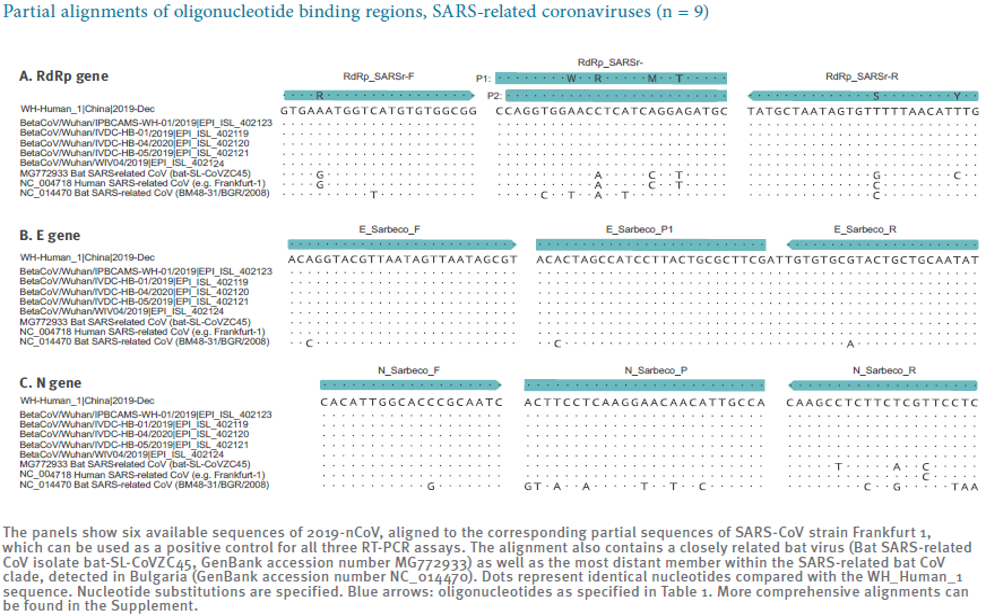
The low sensitivity of the test would explain why both tests performed on March 20th and 24th respectively were negative. On the contrary, as some studies3 showed, the accuracy of the test currently used for the diagnosis of Covid-19 is around 95-97% (low number of false positives). In fact, the genes that are amplified by the RT-PCR technique are highly specific genes of the virus (RNA-polymerase gene, N gene and E gene; figure 1).
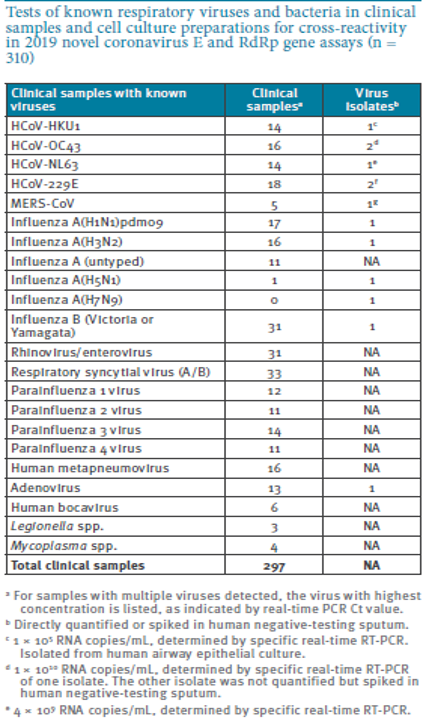
For these genes, no significant cross-reactivity is reported with genes belonging to other types of Coronavirus or to other RNA-virus families or respiratory bacteria (figure 2)4.
At the same time, it could be assumed that in the course of the disease the virus follows a descending and then ascending tropism. In other words, the virus can be initially localized in the upper respiratory airways (nose-pharynx), and then it can pass through the trachea, towards the bronchi, the bronchioles and finally the alveoli. Here, more precisely on the capillaries, there are receptors for the angiotensin-converting enzyme receptors (ACE 2-receptors) where the virus seems to have marked target predilection4 to sneak into host cells (figure 3). In the convalescence phase, when the viral load decreases, the defection of the virus proceeds for mechanical reasons (persistent coughing) in the opposite direction: from the alveoli to the nasopharynx.
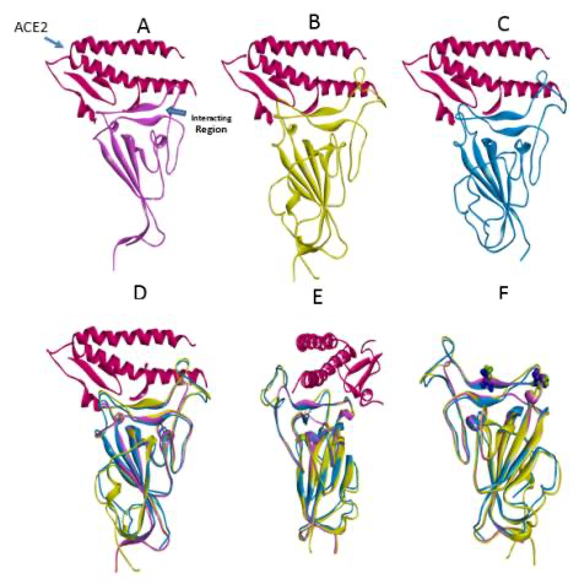
Figure 3. Coronavirus spike proteins. The spike proteins in complex with the RBD of ACE2 (dark pink) are shown in figure A), Bat-CoV, in figure B) SARS-CoV, and in figure C) SARS-CoV-2. A comparison between the three spike proteins are shown in figure D) and a 45-degree turn is also shown in figure E). The location of the main residues mutated in SARS-CoV (positions 479 and 487) and SARS-CoV-2 are shown in figure F) (green and blue).
This trend could explain why, after a first positive nasopharyngeal test followed by two negative tests, a new positive test result emerged. At the time of viral regression, a clinical relapse of the disease may occur, as for the case of the patient under examination.
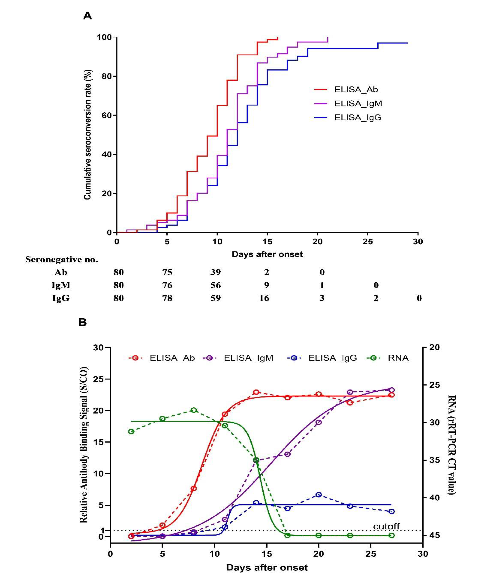
When the diagnostic test gave again a positive result, an intravenous sample was taken for serum storage to get a preview of the patient’s serological profile. Regarding serological markers, the papers currently available in the literature do not refer to clinically remitted patients with a positive test result after two negative tests. In a recent study, carried out at Zhejiang University Hospital (China) 80 patients with COVID-19 were tested for antibodies against SARS-Cov-2. The seroconversion rate showed that the first serological markers that appeared are the total antibodies (median of 9 days after the onset of the disease), followed by the IgM (median of 10 days post-onset) and finally the IgG (median of 12 days post-onset)5 The cumulative seroconversion curve showed that the rate for Ab, IgM reached 100% and IgG reached 97.1% on day 16, 21 and 29 post symptoms onset, correspondingly. The antibody levels increased rapidly since day 6 post-onset. The decline of the viral load co-occurred with the rising of the antibody levels (Figure 4). These data are, however, partial because the observation period (25 days) after the onset of the disease is too short to observe a reduction of at least the IgM level. These data are, however, partial because the observation period (25 days) after the onset of the disease is too short to observe a reduction of at least the IgM level.
Moreover, it is not known (and this is the crucial point) what is the auto-antibody status of a patient where the disease seems to have recurred: at the time of possible relapse, is it more likely that the IgG titer increase or an IgM rebound emerge after an initial drop of the IgM in the asymptomatic period?
- Reinfection
The patient’s immune system succeeded in defeating the virus, but before being discharged, the patient contracted the infection again. The virus responsible for the reinfection belongs to the same family, but with new genetic mutations conferring it as a different strain compared to the virus responsible for the first infection. These new genetic mutations confer different pathogenicity and cause the development of new IgM and IgG. However, the immune system takes time to “get used” to the new virus and to respond to a new infection. This triggers again the fight between the immune system and the new pathogen during which the disease occurs. If the latter hypothesis were true, there would be three implications:
- The asymptomatic patient with a new positive swab should be closely monitored after discharge at home;
- Assuming that in the future the diagnosis of the disease will be performed by serological tests, there will be a need to constantly renew the IgM and IgG dosing kits compared to those currently used, which are only able to dose IgM and IgG directed against one SARS-CoV-2 strain. In fact, if reinfection occurs due to a new viral strain, the antibodies developed against the virus will also be new.
- Therapy with plasma from already infected and convalescent patients (plasma containing preformed IgG against the old SARS-CoV-2) would no longer be sufficient to fight a new mutant of SARS-CoV-2. Therefore, new drugs should be adopted that act on common pathogenetic mechanisms to all viral strains.
Conclusions
New studies containing data on a higher number of patients of this type (“molecular relapse” without real clinical relapse) are needed in order to clarify which of these three hypotheses is the most accredited. Moreover, the study of the serological profile of these patients seems to be interesting in the future. The results of these studies will be important to formulate new hypotheses on the pathophysiological mechanisms at the basis of this disease in order to be able to fight it with the best possible resources.
References
- Leroux E. et al., Orphanet J Rare Dis. 2008. doi: 10.1186/1750-1172-3-20
- Vademecum per la cura delle persone con malattia da COVI-19; Edizione 2.0, 13 marzo 2020 (SIMIT Sezione Regione Lombardia).
- Corman V.M. Euro Surveill. 2020. doi.org/10.2807/1560-7917.ES.2020.25.3.2000045
- Ortega J.T. et al. EXCLI J. 2020. doi: 10.17179/excli2020-1167.
- Lou B. et al. 2020 Apr;23. doi.org/10.1101/2020.03.23.20041707
You may also like this

COVID-19 – What is the CT value and what does it convey about infectivity?

COVID-19 and vaccines: Can the transmission of the virus be stopped?

Covid-19 – Vaccines options available: how to choose?

Covid-19 – Recovery in symptomatic and asymptomatic patients: post-COVID-19 Syndrome

Thank you for your sharing. I am worried that I lack creative ideas. It is your article that makes me full of hope. Thank you. But, I have a question, can you help me? https://accounts.binance.com/uk-UA/register-person?ref=V3MG69RO
Thank you for your sharing. I am worried that I lack creative ideas. It is your article that makes me full of hope. Thank you. But, I have a question, can you help me? https://accounts.binance.com/uk-UA/register?ref=WTOZ531Y
Thank you for your sharing. I am worried that I lack creative ideas. It is your article that makes me full of hope. Thank you. But, I have a question, can you help me? https://accounts.binance.com/de-CH/register-person?ref=UM6SMJM3
Thanks for sharing. I read many of your blog posts, cool, your blog is very good. https://accounts.binance.com/ur/register?ref=FIHEGIZ8
Thanks for sharing. I read many of your blog posts, cool, your blog is very good. https://accounts.binance.com/es/register-person?ref=WTOZ531Y
Can you be more specific about the content of your article? After reading it, I still have some doubts. Hope you can help me. https://www.binance.com/sl/register?ref=W0BCQMF1
Can you be more specific about the content of your article? After reading it, I still have some doubts. Hope you can help me. https://accounts.binance.com/sv/register?ref=V2H9AFPY
Thank you for your sharing. I am worried that I lack creative ideas. It is your article that makes me full of hope. Thank you. But, I have a question, can you help me?
Can you be more specific about the content of your article? After reading it, I still have some doubts. Hope you can help me.
Can you be more specific about the content of your article? After reading it, I still have some doubts. Hope you can help me.
Thank you for your sharing. I am worried that I lack creative ideas. It is your article that makes me full of hope. Thank you. But, I have a question, can you help me?
Thank you for your sharing. I am worried that I lack creative ideas. It is your article that makes me full of hope. Thank you. But, I have a question, can you help me?
Thanks for sharing. I read many of your blog posts, cool, your blog is very good.
Your point of view caught my eye and was very interesting. Thanks. I have a question for you.
Thank you for your sharing. I am worried that I lack creative ideas. It is your article that makes me full of hope. Thank you. But, I have a question, can you help me?
I don’t think the title of your article matches the content lol. Just kidding, mainly because I had some doubts after reading the article.
Thank you for your sharing. I am worried that I lack creative ideas. It is your article that makes me full of hope. Thank you. But, I have a question, can you help me?
Thanks for sharing. I read many of your blog posts, cool, your blog is very good.
Your article helped me a lot, is there any more related content? Thanks!
Can you be more specific about the content of your article? After reading it, I still have some doubts. Hope you can help me.
I don’t think the title of your article matches the content lol. Just kidding, mainly because I had some doubts after reading the article.
Thank you for your sharing. I am worried that I lack creative ideas. It is your article that makes me full of hope. Thank you. But, I have a question, can you help me?
Can you be more specific about the content of your article? After reading it, I still have some doubts. Hope you can help me.
Thanks for sharing. I read many of your blog posts, cool, your blog is very good. https://www.binance.com/ES_la/register?ref=T7KCZASX
Your article helped me a lot, is there any more related content? Thanks! https://accounts.binance.com/ru-UA/register?ref=OMM3XK51
Can you be more specific about the content of your article? After reading it, I still have some doubts. Hope you can help me.
Can you be more specific about the content of your article? After reading it, I still have some doubts. Hope you can help me.
Your point of view caught my eye and was very interesting. Thanks. I have a question for you.
EPL중계
I don’t think the title of your article matches the content lol. Just kidding, mainly because I had some doubts after reading the article. https://www.binance.com/en-IN/register?ref=UM6SMJM3
umsuka
hey there and thank you for your info – I have certainly picked up something
new from right here. I did however expertise some technical points using this site,
as I experienced to reload the website many times previous to I could get it to
load correctly. I had been wondering if your hosting is OK?
Not that I am complaining, but sluggish loading instances times will sometimes affect your placement in google and
could damage your quality score if advertising and marketing with Adwords.
Anyway I’m adding this RSS to my email and could look out for a lot more of your respective interesting content.
Ensure that you update this again very soon.
Hello There. I discovered your blog the usage of msn. This is an extremely neatly written article.
I will make sure to bookmark it and come back to read
more of your useful information. Thank you for the post.
I’ll definitely comeback.
Hi there! I could have sworn I’ve visited this site before but
after looking at some of the articles I realized it’s new to me.
Anyhow, I’m certainly happy I came across it and I’ll be bookmarking it and checking back regularly!
当你听说某个新出的DeFi协议或AI应用,但又记不住官网域名时,来Cryptify Hub搜一下分类。但当你打算往里面充钱或连接钱包时,请务必再次通过多个独立渠道核实网址真实性。导航站可以给你参考,但安全只能靠自己。
You’re so awesome! I don’t think I’ve truly read through a single thing like that before.
So wonderful to discover someone with original thoughts on this subject matter.
Really.. thank you for starting this up.
This website is one thing that’s needed on the internet, someone with a bit of originality!
If some one desires expert view on the topic of blogging and site-building then i recommend him/her to
pay a visit this blog, Keep up the pleasant job.
This is the perfect webpage for anybody who wishes to understand this topic.
You realize so much its almost tough to argue with you (not that I actually will need to…HaHa).
You definitely put a brand new spin on a subject which has been written about for a long time.
Wonderful stuff, just excellent!