
by Domenico Gangemi, Giuseppe Scarlata, Maria Chiara Rosace, Antonino Napoleone | November 12, 2020.
Europe is in the midst of the second wave COVID-19, a pandemic that has now almost entirely marked this 2020, yet the questions of scientists and the general population are still many. The situation in Italian hospitals is on the verge of criticality as ICU beds are increasingly close to saturation. In these conditions, in order to delay the collapse of the National Health System, it is necessary to trace the infection adequately. Although the course of the infection is in many cases unpredictable, the diagnosis at a stage when the clinical picture is not yet established (slight coughing cough, absence or decimals of fever, trivial colds without the need for oxygen therapy) could lead to less hospitalisation of patients. Compared to the first wave of the pandemic, we have more instruments to trace the contagion, which differ from each other in their characteristics and sense of use.
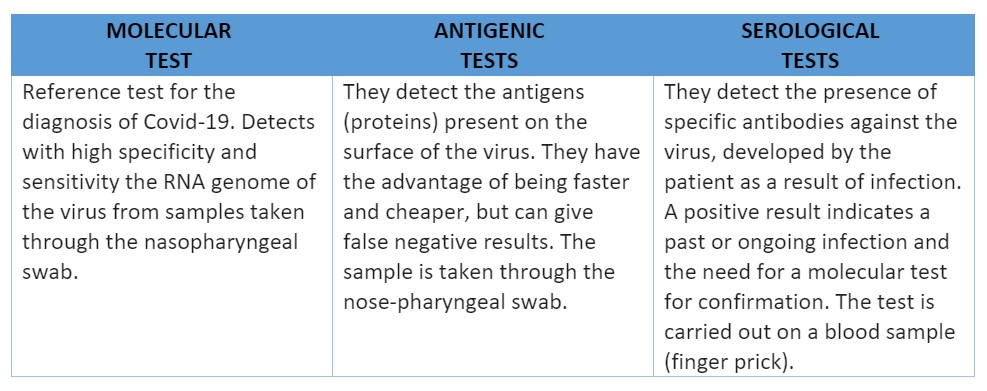
In the perspective of rational and sustainable use of health resources, not all tests can be used indiscriminately (Figure 1).

The most frequent questions asked by the population are: What tools do we have available to track contagions? For which patients is it indicated for that use? If they are to be used, what are the criteria for choosing the tests available? Before answering these questions, a number of premises are necessary.
Definitions
– Isolation: separation of infected people from the rest of the community for the duration of the infection period, in an environment and conditions that prevent transmission of the infection.
– Quarantine: restriction of movement of healthy people for the duration of the incubation period (the average period from contact with the infectious agent to the onset of symptoms).
– Suspicious case: patient with symptoms compatible with SARS-CoV-2 infection. The concept includes symptomatic close contact.
– Positive case: Patient who tested positive for SARS-CoV-2 in the molecular test.
– Asymptomatic close contact: A person who does not have compatible symptoms but has come into contact with a molecular test positive case.
Tests currently available
Molecular test: Real Time PCR
It represents the reference test for the diagnosis of COVID-19 (to learn more about “From swab to result“). The detection of SARS-CoV-2 viral RNA is performed in the laboratory by clinical specimens (usually nasopharyngeal or oropharyngeal swabs). It is able to:
- Detect the pathogen even at low viral load in symptomatic, pre-symptomatic or asymptomatic subjects;
- Measure and quantify the initial concentration of the viral genome.
The result can be achieved in a minimum of 3-5 hours but organisational and logistical situations can take up to 1-2 days.
For the purpose of reporting cases in the surveillance system, only positive results obtained through this test in the regional reference laboratories or by the identified and authorised laboratories are considered as official (https://www.epicentro.iss.it/coronavirus/sars-cov-2-sorveglianza).
The sensitivity of the molecular test is higher than the antigenic test (the risk of false-negative test results is lower).
Rapid antigenic test
The biological sample is always obtained by the nasal and naso\oro-pharyngeal swab. Unlike molecular tests, antigenic tests detect the presence not of the viral genome but of proteins (antigens) present on the surface of the virus by specific antibodies directed against them (Figure 2).

Why prefer a rapid antigenic test to a molecular test?
- faster execution (30-60 minutes);
- lower cost;
- there is no need for specialised personnel.
These features would make this test useful for early diagnosis or screening. In fact, molecular tests have a higher sensitivity (lower percentage of false negatives) before the onset of symptoms, while in the phase immediately following the symptoms rapid antigenic and molecular tests have a similar sensitivity.
When, then, would it make sense to use the rapid test? The rapid test could be used to identify asymptomatic contacts in confirmed cases, even if it is not specifically authorised for this purpose. False negatives can, in fact, be obtained if:
- the concentration of antigens is below the detection limit of the test (e.g. if the sample was taken too early compared to the hypothetical time of exposure to the virus);
- the sample has been taken, transported or stored improperly.
Therefore, a negative test result is not sufficient to completely rule out the possibility of SARS-CoV-2 infection. The negativity of the sample, under strong suspicion of COVID-19, should be confirmed by molecular testing, which still remains the most sensitive and reliable diagnostic tool.
At present, the available data of the various antigenic tests are 70-86% for sensitivity and 95-97% for specificity.
The sensitivity and specificity of rapid antigenic tests will have to be evaluated for their predictive values during their technological development.
Serological tests
They detect the presence of antibodies developed by the patient following a previous infection. Serological tests are carried out on a blood sample obtained by finger pricking, and identify specific antibodies against the virus, which should appear a few weeks after infection (see “Serological tests: how do they work?“). They are not able to confirm whether or not an infection is present, so in the event of a positive result, a molecular swab test must be requested for confirmation (Table 1).
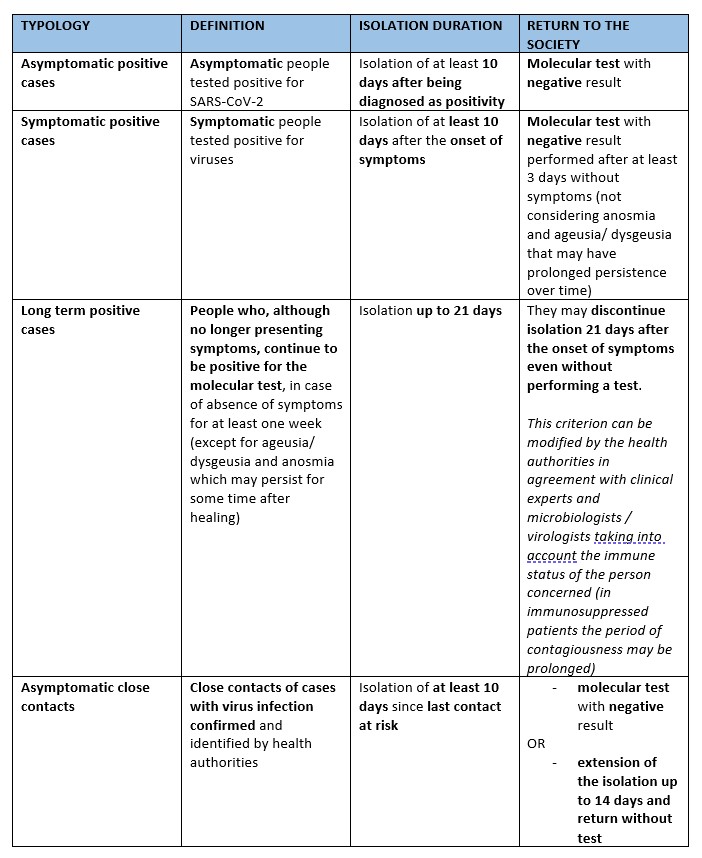
Guidelines for the duration and end of the isolation and quarantine.
- Positive cases: return to the community must meet two criteria:
- an isolation period of at least 10 days after the onset of symptoms (not considering alterations in taste and smell that may persist longer);
- molecular test with negative results performed at least 3 days after the symptoms have disappeared.
All in all, therefore, it can be assessed whether a positive case can end the isolation period and only return to the community 10 days after the onset of symptoms. If the patient no longer presents symptoms during the last 3 days of these 10 days, the molecular test can be requested and carried out. If the molecular test is negative, the patient can interrupt the isolation from the community (Table 2).
- Long-term positive cases: in some cases, after 10 days of isolation of which the last 3 days without symptoms, the molecular test may still be positive. After 7 days without symptoms, however, these patients can only interrupt the isolation 21 days after the first symptoms have appeared.
The ministerial note specifies that these criteria may be modulated by health authorities in agreement with clinical and microbiologist or virologist, taking into account the immune status of the persons concerned (in immunodepressed patients the period of contagiousness may be prolonged).
- Asymptomatic close contact: These patients require a 14-day quarantine period since last exposure or a 10-day quarantine period since last exposure if an antigenic or molecular test is performed and the test is negative on day 10.
Which tests and to which individuals?
According to the explanations mentioned above, it is clear that tests have different meanings. Each type of subject has indications to carry out a particular type of test, depending on specific well-defined circumstances.
- Molecular test:
- suspicious case;
- asymptomatic close contact that becomes symptomatic during quarantine;
- screening for health care worker/personnel operating in high-risk contexts;
- an asymptomatic subject before hospitalization or entry into closed communities (e.g. residences for the elderly);
- subjects placed in isolation to obtain confirmation of recovery;
- asymptomatic close contact in quarantine for closure at 10 days;
- confirmation for subjects who tested positive for the rapid antigenic test.
- Rapid antigenic test:
- subjects with few symptoms who have had no contact with established cases;
- close contact with confirmed asymptomatic cases;
- asymptomatic subjects coming from areas at risk;
- community screening for public health reasons;
- asymptomatic individuals who perform the test on a voluntary basis (e.g. for work or travel).
Conclusions
The ministerial indications, especially with regard to the use of rapid pads, may be subject to change as a result of new research and the development of increasingly advanced kits. In order to limit contagion and facilitate case tracking, the importance of correct updating by the community and information that is as “scientific” and accurate as possible should be stressed. Although the new diagnostic tools and tracking technologies may represent a considerable advantage compared to the early stages of the pandemic, which places the conditions for more conscious and timely action, it is essential to comply with the recommendations and health and hygiene directives aimed at avoiding the collapse of the national health system and protecting the health of citizens. Share and have faith in medical sciences rather than the media.
References
- Nota tecnica ad interim. Test di laboratorio per SARS-CoV-2 e loro uso in sanità pubblica. Aggiornata al 23 ottobre 2020. Roma: Ministero della Salute, Istituto Superiore di Sanità; 2020.
- European Commission. COVID-19 in vitro diagnostic devices and test methods database. Brussels: EC; 2020. https://covid-19-diagnostics.jrc.ec.europa.eu/ ).
- Dinnes J, Deeks JJ, Adriano A, Berhane S, Davenport C, Dittrich S, Emperador D, Takwoingi Y, Cunningham J, Beese S, Dretzke J, Ferrante di Ruffano L, Harris IM, Price MJ, Taylor-Phillips S, Hooft L, Leeflang MMG, Spijker R, Van den Bruel A. Rapid, point‐of‐care antigen and molecular‐based tests for diagnosis of SARS‐CoV‐2 infection. Cochrane Database of Systematic Reviews 2020, Issue 8. Art. No.: CD013705. DOI: 10.1002/14651858.CD013705.
- Castro R, Luz PM, Wakimoto MD, Veloso VG, Grinsztejn B, Perazzo H. COVID-19: a meta-analysis of diagnostic test accuracy of commercial assays registered in Brazil [published online ahead of print, 2020 Apr 18]. Braz J Infect Dis. 2020;S14138670(20):530029. DOI:10.1016/j.bjid.2020.04.003.
- Russo A, Minichini C, Starace M, et al. Current status of laboratory Diagnosis for COVID-19: a narrative review. Infect Drug Resist. 2020;13:2657-2665. doi:10.2147/IDR.S264020
- SARS-CoV-2 Diagnostic pipeline. https://www.finddx.org/covid-19/pipeline/
- Circolare ministeriale n. 32850 del 12 ottobre 2020 “COVID-19: indicazioni per la durata ed il termine dell’isolamento e della quarantena”.
- https://www.iss.it/documents/20126/0/Rapporto+ISS+COVID-19+n.+11_2020+tampone.pdf/e349b0ee-45a4-03e6-6cca-5b8e3453fcb0?t=1587114321506
- https://www.kyvobio.com/koop/cat-sars-cov-2-antigens-proteins-and-5102.html
You may also like this

Europe’s top universities: Where research thrives in 2025

Microbes and Mood: Deciphering the Connection for a Happier You!

Can’t solve a maze? Ask a slime mould!

The neurobiology behind the Christmas spirit
