
by Domenico Gangemi, Antonino Napoleone, Giuseppe Scarlata | May 4, 2020
Interview to Mr. S.C.
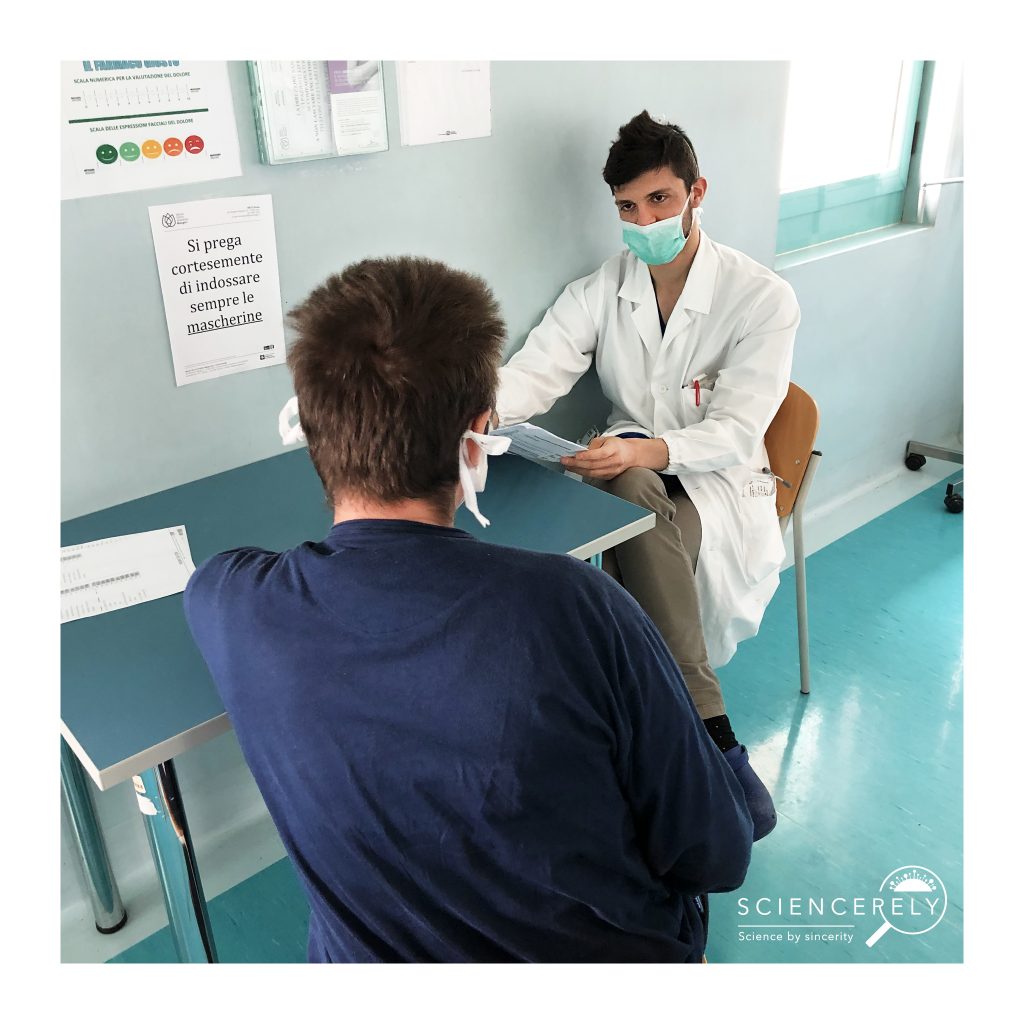
Here is presented the interview of Mr. S.C., 45 years old, recovered from COVID-19. Before the interview the patient gave his informed consent for the processing of his personal information. The interview will be reported anonymously.
The patient was discharged from the Hospital “San Matteo” in Pavia and he has been transferred to a local hospital for continuing the treatment. The interview has been carried out in this second hospital.
During the hospitalization in the COVID-19 unit, the patient was treated for several days with CPAP (Continuous Positive Airway Pressure), a non-invasive mechanical ventilation which allows to supply oxygen at positive pressure to the patient, ensuring an adequate pulmonary ventilation.
The purpose of the interview is merely narrative-descriptive: an intimate and emotional environment is set up, where, by retracing the patient’s clinical history, the feelings, fears and emotions experienced during the entire period of illness are illustrated gradually building to a unique climax.
*
- I will start asking what kind of symptoms did you experience first?
I started experiencing the first symptoms on March 4. In those days I was on holidays – I work in a bakery. It all started with fever at 38 °C. Slowly the fever raised up to 39.5 °C. Then I called the emergency number (112), but for two consecutive days the operators refused to send an ambulance to my home.
- Did you have any other symptoms?
Chest pain, a burning sensation, especially when I coughed. I also started vomiting and, when I went to the pharmacy to get medicines, I even fainted. One of my two sons was there with me and drove me home. My family and I started to be very worried: we felt the urgency to go to the hospital, because I felt not normal neither good. We called the emergency number (112) again and we said to the operators that, if they had not taken me immediately up to the hospital, then I would have gone on my own with my car. The operators told me that going to the Emergency Recovery by my own car was forbidden, it was against the law and they continued refusing to pick me up at home.
- Why do you think 112 refused to pick you up?
I don’t know, but they didn’t come to pick up me. Maybe they were waiting for my condition to get worse…
- How did you get the diagnosis?
On March 11 I went to the San Matteo Hospital’s ER on my own. I know that I should not have gone to ER on my own – I should have waited for the ambulance, but I did not have any choice. I had the chest X-ray and blood tests, all consistent with COVID-19 diagnosis. The COVID-19 swab was positive.
- Did you need to be admitted to the Intensive Care Unit?
No. After 2 days in the ER, on March 13 I was admitted to the unit dedicated to less critical patients, who needed less respiratory assistance but still with the need for oxygen. Until March 17, my health condition got much better. The test was repeated on March 17 and it was positive again, so doctors decided to transfer me to another unit.
- What was the difference compared to the first unit?
The second unit I was moved to was dedicated to oxygen-free recovering patients – so as apparently it was initially. Afterwards many patients – including me – started to feel much worse.
- What happened then?
On April 18 I got worse again – I had very strong chest pain, especially on the right side, the cough got worse and I needed more and more oxygen. I underwent an emergency chest CT scan and doctors found a pulmonary embolism, for which they immediately started treating me with drugs.
*
During the hospitalization, Mr. S.C. was treated with a high-dose anticoagulant to dissolve the thrombi in the pulmonary arteries. He was treated with non-invasive mechanical ventilation by CPAP mode.
*
- When did you start suspecting to be affected by COVID-19? Were you afraid? What did you think at the beginning?
At first, I didn’t know what was wrong with me. When I was at home, I thought I had flu.
- What did you think when you got the confirmed diagnosis of COVID-19?
I wasn’t too scared. I thought I’d get better.
- Even when your condition worsened?
Yes, at that stage I started to be afraid.
- Were you afraid of losing someone or something if you were not cured of COVID-19?
I was worried to leave too many things uncompleted, like my house – I’m still building it. But above all I was afraid that I would never be able to see my wife again, to whom I have been married for 25 years, and that I would not be able to see my sons getting married, since they are still too young.
- Not being able to recognize the faces of doctors and nurses behind masks and protective clothes, made you feel like they were more emotionally detached from you? What differences did you experience in your relationship with doctors compared to an ordinary medical visit?
They were amazing, they took care of me like for a son or a brother. I felt more assisted than when I’ve undergone an ordinary check-up at the hospital. I was monitored throughout the day; doctors and nurses were always present and available for me.
- How do you think you got the infection?
I got it from my wife. The dynamic was pretty clear. My wife works in a nursing home near Pavia. A few days before I had a fever, she received a phone call while she was at home: they told her that she had to be careful because in the nursing home there was a positive case she had been in contact with a few days before. On March 9, the same day that I developed the first symptoms, she developed the same symptoms. On the other hand, before we got infected, we behaved exemplarily and we were very cautious: when we heard the news from China about the risk of a pandemic, we started to limit our contacts with friends and relatives even before the outbreak of the first cases in Italy.
• After discovering the first positive case at the nursing home, what kind of actions or decisions were taken? Have the managers thought about closing the nursing home?
No, they have initially ignored what happened, like everyone else.
- But it has been not enough having one positive case…
It has been not enough because they even told my wife and staff not to wear masks (which, by the way, were not enough) because they could frighten the elderly residents. In a nutshell, in order not to create psychological terrorism, they all got infected by the virus.
- Do you remember exactly on which day your wife had contact with the positive patient in the nursing home?
She had the contact two days before we started having a fever, so on March 7. By the same day I started having fever and she started having first respiratory symptoms. When my son picked me up to the ER, she also came with me. Doctors made the swab and she resulted positive to COVID-19. She was admitted to the same unit where I was hospitalized, the same one for the recovering patients. That’s why I have no doubt about how I have been infected by the virus.
- How is your wife now?
She is fine now. She has been discharged before me. When she has been discharged, she cried. She did not want to leave me in the hospital alone. Even though it was forbidden to leave our room, it is always a consolation to know that your partner is in the adjacent room…
- When you were hospitalized, could you hear or see your wife and sons?
Yes, I could only called them on my phone. Everything on the unit was contaminated, but we cleaned everything with the sanitizer almost spasmodically.
- Have you seen them also while you were wearing your CPAP mask?
No, I just spoke with them. I just took two photos but I kept those for myself only (Editor’s note: he shyly smiled).
- How has the hospitalization changed when you had to wear a CPAP mask?
I had a huge discomfort, especially when the fever went down with paracetamol because I was sweating a lot and I felt a sense of choking in my throat. Of course, I couldn’t take it off to dry out the sweat. The greatest discomfort, however, was the noise from the ventilation machine during the night. At first, the noise didn’t allow me to sleep but later I got used to it. Another discomfort, while I was wearing the mask, was the need to feed myself only through a nasogastric tube.
- How long did you keep the CPAP mask on?
For six days and six nights – they have been very long. When the CPAP has been suspended, it has been great to be able to restart eating normally. Gradually doctors suspended oxygen therapy until I have been moved to this hospital.
- Did you feel uncomfortable with other patients in the room or did you feel you had no privacy?
Actually, I could feel having my privacy because during the hospitalization the patient close to my bed started to get worsen, and then he was no longer conscious. He was an elderly man: after a couple of days I could take off my CPAP, but unfortunately, he died. After that another patient arrived in my room and he was in critical condition. When I was discharged, he was still there.
- How did you spend your time when you were in the COVID-19 unit? Were you informed about what was going on in Italy in those days?
I spent my time mainly on the phone. I had no television in my room. The health workers brought me newspapers and magazines. So, I was updated about the situation in Italy.
- May I ask you one more question, maybe a little bit trivial but important to me. What do you miss most about your everyday life and about being free, as before your illness?
I would like to finish building my house. Now it’s going to be a little more difficult because of the bad economic situation we have been facing during this period and because I can’t get help from anyone since we have to respect social distancing.
- Thank you very much.
Can I ask you a question?
- Sure.
Why did you ask me this last question? What did you understand from my answer?
- I wanted to understand the value you place on freedom. From the answer you gave me, I understood that freedom is very important to you.
***
You may also like this

COVID-19 – What is the CT value and what does it convey about infectivity?

COVID-19 and vaccines: Can the transmission of the virus be stopped?

Covid-19 – Vaccines options available: how to choose?

Covid-19 – Recovery in symptomatic and asymptomatic patients: post-COVID-19 Syndrome
