
by Giuseppe Scarlata, Antonino Napoleone, Domenico Gangemi | June 28, 2020
The effects of the pandemic have affected several aspects of society, questioning outdated and stratified beliefs about health and political management models, that are currently inadequate in many contexts. Researchers are competing against the clock to solve the puzzles and reveal all the scientific connections behind the spread of SARS-CoV-2. The effects have affected all social strata, in a direct and indirect way, both from a socio-sanitary and psychological point of view (to deepen the effect of the lockdown on the psyche). On June 27, 2020, 2,553,686 cases were officially registered only in the United States, and according to the latest report of the Centers for Disease Control and Prevention (CDC), 116,413 of those infected are pediatric patients (Figure 1). The data and clinical development of the adult and elderly population have been supported by numerous scientific studies, which have highlighted the different pathophysiological mechanisms behind the infection in the most affected categories. With regard to children, however, there are still several doubts about their correlation with Coronavirus infection. It is still far from ascribing Coronavirus Infectious Disease 19 (COVID-19) among the most common childhood diseases such as measles, chickenpox, rubella, scarlet fever but it would be interesting to better understand and answer several questions that have recently come to our attention: why is the infection less contagious in children? How is it that in most cases there is a slight or no symptomatology? Is SARS-CoV-2 transmissible from mother to child during pregnancy?

Are we talking about an at-risk category?
The Centers for Disease Control and Prevention defines as risk categories of severe forms of COVID-19 elderly people (> 65 years of age), those living in a nursing home or long-term care facility and people of all ages with comorbidities such as:
- chronic lung disease or moderate to severe asthma;
- heart problems;
- hypertension;
- compromised immune system;
- severe obesity;
- diabetes mellitus;
- renal syndromes;
- liver disease.
Children are therefore not considered an at-risk category.
How does that translate clinically?
Recent studies report that children have fairly common mild symptoms such as fever (41.5%) and cough (48.5%). Other symptoms include fatigue, myalgia, nausea, vomiting, and diarrhea. However, serious symptoms cannot be completely excluded. The first serious case of childhood infection was reported on January 27, 2020, in Wuhan: a 13-month-old child who came to the attention of healthcare workers had initially frequent vomiting and diarrhoea, which quickly developed acute symptoms including shortness of breath, oliguria and, only six days later, acute respiratory distress syndrome (ARDS), septic shock and acute renal failure. No comorbidities were present in this case.
Is there any connection between the Coronavirus and the Kawasaki Syndrome in children?
In Italy, interesting reports have been received, analyzed, and recently published in The Lancet: in the pediatrics unit of the Papa Giovanni XXIII Hospital in Bergamo, an incidence of Kawasaki Syndrome was found thirty times higher after COVID-19. It is a rare form of vasculitis, which causes inflammation of small and medium blood vessels at a systemic level, and mainly affects children between 1 and 5 years old. This syndrome is characterized by frequent myocardial and/or gastrointestinal involvement and high fever (≥38°C), signs of shock, abdominal pain, but interstitial pneumonia typical of COVID-19 does not appear to be present (Figure 2). The Italian national health institute, Istituto Superiore di Sanità (ISS) has expressed its opinion pointing out that, even in the absence of a shared European case definition, it is possible to correlate SARS-CoV-2 infection and Kawasaki Syndrome, albeit with numerous limitations.
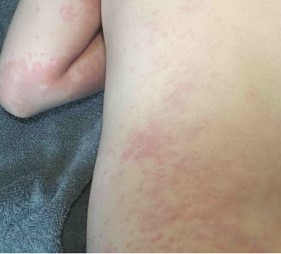
Figure 2. Diffuse rash appearing mildly erythematous with blanching macules and patches involving the trunk and extremities.
How it can be explained the lower prevalence in children?
Several studies are in progress but recently it has been shown that a reason could be related to the angiotensin-2 conversion enzyme (ACE2) which promotes the entry of SARS-CoV-2 into the target cells allowing its anchorage and subsequent penetration. A recent study published in the medical journal JAMA, in fact, showed that the expression of ACE2 at the level of nasal epithelial cells is age-dependent: i.e. it has been shown that this receptor is less expressed in children, but more present in adults, since its expression increases with the age, making adults more susceptible to get the SARS-CoV-2 infection (Figure 3).
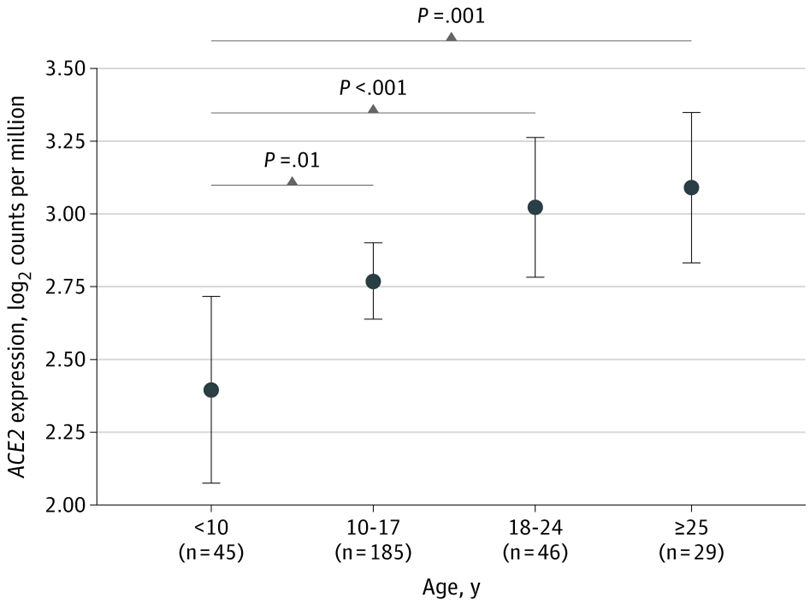
Data are means (data points) and 95% confidence intervals (error bars) for angiotensin-converting enzyme 2 (ACE2) gene expression in younger children (aged <10 years), older children (aged 10-17 years), young adults (aged 18-24 years), and adults (aged ≥25 years). Gene counts are shown as logarithmic (log2) counts per million. P values are from linear regression modeling in which ACE2 gene expression in log2 counts per million was the dependent variable and age group was the independent variable.
Pregnant women and babies
The clinical features of pregnant women affected by COVID-19 appear to be similar to those reported in non-pregnant adult patients. Recent studies have focused on the possible vertical transmission (i.e. from mother to child) of the infection by detecting the presence of class M antibodies (IgM) against SARS-CoV-2 in infant serum. During pregnancy, in fact, the mother is able to transfer her antibodies to the fetus through the placenta, to offer a certain level of immune protection to the newborn in the first months of life. The only placenta-transferable antibodies belong to the class G (IgG), and the presence of IgM in infant serum would suggest a possible transmission of intrauterine infection (role of IgG and IgM in the immune response against infections). Therefore, if the mother does not transfer IgM to the fetus, then the explanation could be that SARS-CoV-2 is able to cross the placenta and the infant starts producing IgM as the first defense response against the infection. On the other hand, however, none of the infants tested has ever tested positive for swabs and diagnostic tests performed at birth and repeated up to 16 days after delivery. The study and antibody tests (serological tests) are a very important tool to understand the course of an infection and what kind of response triggers the immune system to defend itself. It would be interesting to understand in more detail what type of immune response triggers newborns against SARS-CoV-2 and, above all, what differences are found compared to other pediatric diseases. Further studies are certainly necessary, but there is evidence that after childbirth the same modes of getting the infection persist in both adults and children, and secondly that SARS-CoV-2 is able to cross the placenta and be transmitted to the fetus via intrauterine transmission. In fact, it is under evaluation of the possibility of including SARS-CoV-2 into the TORCH complex, a collection of infections that can cause disease in the newborns following the transplacental or perinatal acquisition and that includes Toxoplasma gondii, Rubella virus, Cytomegalovirus, Herpes Simplex Virus.
In conclusion
Although the mechanisms of infection in children and during pregnancy must be further investigated, it can certainly be said that the current data are quite relevant. Preventing infection is as important for the adult as it is for the children, by taking the correct measures of prevention and social distancing and why not, even by properly informing children about what is happening. Even though children commonly get mild or no symptoms, they need to be considered anyway as a huge potential source of transmitting infections to adults, elderly people, and other children as well. The truth is that we do not know what will happen in the coming months, whether the “second wave” will be more or less violent, but it is a priority to protect and support children and pregnant women, offering maximum support and advice to limit fears, insecurities, and potential consequences. Another topic that is rather controversial at the moment is the reopening of schools for the next year and what preventive measures to take. After having spent half the school year with distancing lessons and examinations, it is legitimate to wonder and be concerned about what will happen in the coming months. This should lead to well-considered decisions supported by technical-scientific assessments regarding obstetrics, pediatrics, and schools. Share and have faith in medical sciences rather than the media, we all need to look to the future by prioritizing and investing in the real important causes.
References:
- https://www.aspct.it/settori_sanitari/comitato_per_la_lotta_alle_infezioni_ospedaliere%28cio%29/documentazione/infezioni_ospedaliere_cap1.pdf
- Bialek, S., Gierke, R., Hughes, M., McNamara, L. A., Pilishvili, T., & Skoff, T. (2020). Coronavirus disease 2019 in children — United States, February 12–April 2, 2020. Morbidity and Mortality Weekly Report, 69(14), 422–426. https://doi.org/10.15585/MMWR.MM6914E4
- https://www.cdc.gov/coronavirus/2019-ncov/need-extra-precautions/people-at-higher-risk.html
- https://www.cdc.gov/coronavirus/2019-ncov/cases-updates/cases-in-us.html
- Rapporto ISS COVID-19 n. 29/2020. Indicazioni ad interim su malattia di Kawasaki e sindrome infiammatoria acuta multisistemica in età pediatrica e adolescenziale nell’attuale scenario emergenziale da infezione da SARS-CoV-2. Gruppo di lavoro ISS Malattie Rare COVID-19. Versione del 21 Maggio 2020.
- https://www.worldometers.info/coronavirus/
- Bunyavanich, S., Do, A., & Vicencio, A. (2020). Nasal Gene Expression of Angiotensin-Converting Enzyme 2 in Children and Adults. JAMA – Journal of the American Medical Association, 20–21. https://doi.org/10.1001/jama.2020.8707
- Dong L, Tian J, He S, Zhu C, Wang J, Liu C, Yang J. Possible Vertical Transmission of SARS-CoV-2 From an Infected Mother to Her Newborn. JAMA. 2020 Mar 26. doi: 10.1001/jama.2020.4621.
- Zeng H, Xu C, Fan J, Tang Y, Deng Q, Zhang W, Long X. Antibodies in Infants Born to Mothers With COVID-19 Pneumonia. JAMA. 2020 Mar 26. doi: 10.1001/jama.2020.4861.
- Kimberlin DW, Stagno S. Can SARS-CoV-2 Infection Be Acquired In Utero? More Definitive Evidence Is Needed. JAMA. 2020 Mar 26. doi: 10.1001/jama.2020.4868.
- Muldoon, K. M., Fowler, K. B., Pesch, M. H., & Schleiss, M. R. (2020). SARS-CoV-2: Is it the newest spark in the TORCH ? Journal of Clinical Virology 127 (2020). https://doi.org/10.1016/j.jcv.2020.104372.
You may also like this

Europe’s top universities: Where research thrives in 2025

Microbes and Mood: Deciphering the Connection for a Happier You!

Can’t solve a maze? Ask a slime mould!

The neurobiology behind the Christmas spirit
