
By Maria Chiara Rosace, Antonino Napoleone | January 19, 2022.
Edited by Ivy Rose Sebastian.
Burying the dead is a ritual of great social significance and is rooted in ancient origins, but did you know that it is not a practice exclusive to Homo sapiens? Surprisingly, some insects, including bees, ants, and termites, also take care of the corpses of their deceased co-specifics, often burying them. It has long been known that burial activities among insects, especially ants, are always carried out only by the worker-ants, whose job it is to be the colony’s gravediggers. A few years ago, a new study published in the BMC Evolutionary Biology journal showed that ant queens also perform this behaviour. However, the real reason for the burial is certainly not to commemorate or remember their deceased sisters.
So why do ants bury their dead?
Social insects form densely packed societies in environments with high pathogen loads. Nevertheless, they have collective defences that have evolved to mitigate the impact of diseases and the risk of infection, leading to the protection of the colony members. Grooming, for example, greatly reduces the risk of infection by allowing efficient mechanical removal of hyphae or fungal spores. Disposal of corpses is also a form of preventive defence that ensures the health of the community. This is a form of immunity known as social immunity. In mature colonies, tasks such as these are typically considered part of the duties of worker-ants. In newly founded colonies, when workers are not yet present, neo-queens cannot benefit from these forms of protection and can have high mortality rates. The impact of pathogens may be exacerbated in species where several queens establish colonies together, as the risk of contracting diseases from other co-founders is higher.
Nipping the risk of disease in the bud
To prevent the risk of infection and disease transmission, queens of some species, including Lasius niger, the black garden ant (Figure 1), have evolved burial behaviours towards other deceased queens.

Why do ants bury their dead? © Katja Schulz from Washington, D. C., USA – Black Garden Ant tending Citrus Mealybug
Burial is in fact an extraordinarily effective practice. In the case of common fungal infections, for example, the release of conidiospores can occur even after the death of the infected individual. In nests co-founded by several queens, the queens themselves seem to dismantle the corpses, either by biting or burying them or simply by transporting them outside of the nest (necrophoresis) to prevent risks of infection (Figure 2).
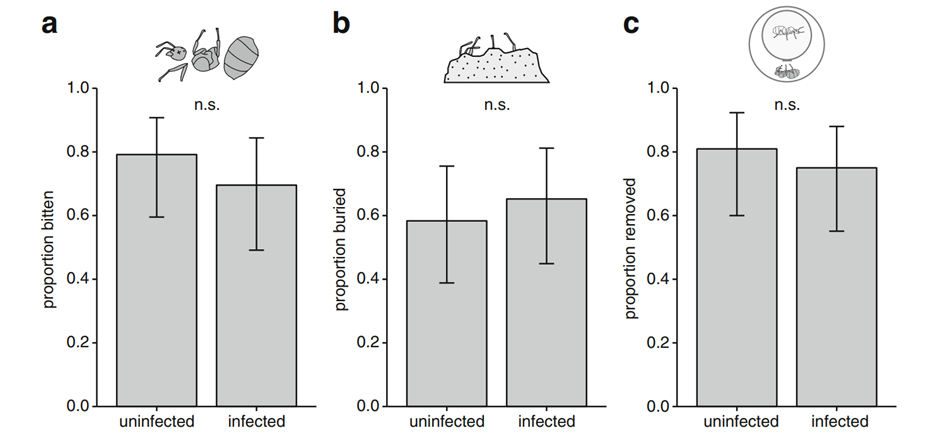
Eusocial insect societies are extraordinary. Edward O. Wilson and Bert Hölldobler referred to them as a superorganism. Extreme cooperation because of the spontaneous organisation is what characterises the ant colony, which “like the cell or the person, […] behaves as a unitary whole, maintaining its identity in space, resisting dissolution and, as a general rule, any fusion with other colonies of the same or alien species. This resistance is very strongly manifested in the fierce defensive and offensive cooperation of the colonial personnel” [William Morton Wheeler, 1911]2.
References
Pull, C.D. and Cremer, S., 2017. Co-founding ant queens prevent disease by performing prophylactic undertaking behaviour. BMC evolutionary biology, 17(1), pp.1-10. https://bmcecolevol.biomedcentral.com/track/pdf/10.1186/s12862-017-1062-4.pdf
Wheeler W. M., 1911. The ant-colony as an organism, Journal of Morphology, 307 – 325 https://zenodo.org/record/1427665/files/article.pdf
You may also like this
Can’t solve a maze? Ask a slime mould!

Science and curiosity: What is the kissing disease?

Science and curiosity: How does the pregnancy test work?
