
by Antonino Napoleone, Domenico Gangemi | August 05, 2021.
It may sound like an advertising title from a pizzeria in Naples, but it is the name of the study carried out by a team of doctors and scientists at the Institute of Pharmacological Research ‘Mario Negri’ in Milan and the Institute of Medical Statistics at the University of Milan, Italy, in collaboration with the International Agency for Cancer Research in Lyon, France. The subject of the study is not just any ordinary food, but it represents a symbol of Italy all over the world, a symbol that has been rooted in the culture and culinary traditions of Italy for centuries. Indeed, according to tradition, the first ‘Pizza Margherita’ was prepared by chef Raffaele Esposito in June 1889, topped with tomatoes, mozzarella and basil to represent the colours of the Italian flag, in honour of Queen Margherita of Savoy visiting Naples. So what inspired the researchers to conduct a study to see whether eating pizza actually protects against the risk of cancer? It was probably for statistical reasons since it is estimated that around 8 million pizzas are made every day in Italy, accounting for a total of almost 2 billion pizzas per year, which according to estimates is the equivalent of around 8 kg of pizza eaten in a year by every Italian. This is without taking into account the trend seen during the previous months of lockdown when the consumption and preparation of homemade pizza literally rose (read more: how did Italian eating habits change during the pandemic?). These are astonishing numbers, which make this study particularly interesting from a nutritional and epidemiological point of view, considering the correlation between diet and cancer incidence.
Methods of the study
The research group investigated the potential preventive role of pizza on cancer risk, using data from an integrated network of several case-control studies conducted in Italy between 1991 and 2000. A case-control study is a retrospective study examining two homogeneous groups of individuals with respect to exposure to a given risk factor: one group had the outcome of interest (cases) and the other had no outcome (controls). The analysis involved a large number of participants, including patients with a confirmed cancer diagnosis (598 patients with oral cavity and pharyngeal cancer, 304 with oesophageal cancer, 460 with laryngeal cancer, 1225 with colon cancer and 728 with rectal cancer) and control individuals (4999 subjects with no cancer). All subjects completed a series of very detailed questionnaires to collect as much data as possible on lifestyle, health, alcohol consumption, smoking exposure, dietary habits and daily pizza consumption. The study cohort was then divided into three groups:
- Group of non-pizza eaters (less than one pizza/month)
- Group of occasional eaters (1-3 pizzas/month)
- Group of regular eaters (1 or more pizzas/week)
Results of the study
Among the three groups examined, regular pizza eaters had a lower risk of developing cancer of the oral cavity, pharynx, oesophagus and colon. The conclusions drawn by the researchers after years of work and advanced statistical analysis suggest that pizza consumption is a favourable predictor of the risk of developing cancer of the digestive tract. However, the researchers added that the health benefits of eating a good pizza include other variables that should not be overlooked. Indeed, the composition of pizza includes mostly carbohydrates (~50%), but also tomato sauce (~20%), mozzarella cheese (~20%) and extra virgin olive oil (~4%), plus other various topping ingredients (Figure 1). In particular, tomato sauce and extra virgin olive oil (EVO) have been the subject of several studies and have been proven for some time to have an inverse association with the risk of developing various types of neoplasia, including those of the digestive tract and larynx. Tomato sauce is rich in antioxidants, vitamins and lycopene, a carotenoid widely studied for its therapeutic, anti-progressive and preventive effect on prostate and digestive tract cancer. The health benefits associated with EVO oil are linked to the presence of monounsaturated fats, alpha-linoleic acid, polyphenols and tocopherols (vitamin E), which have antioxidant, anti-inflammatory, anti-cancer and preventive effects on the onset of cardiovascular disease.
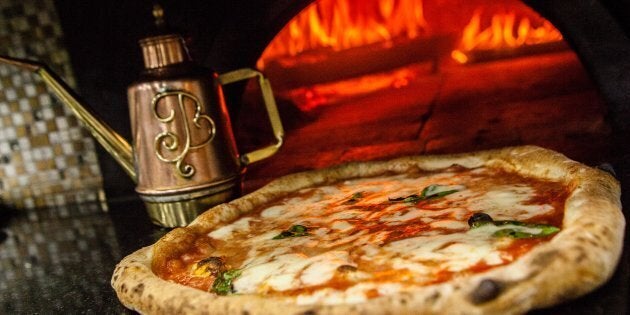
Traditional pizza and the Mediterranean diet
As already mentioned, pizza is one of the best-known and most popular foods of Italian cuisine and is necessarily included in the list of products that are part of the renowned Mediterranean diet. This list of products includes fruit, vegetables, cereals, wholemeal flours, pulses, fish, cheese, nuts and seeds, etc. These are products from the landscape to the table, whose health benefits stem from their variety, freshness and traditional methods of preparation and/or harvesting or cultivation. Pizza can be considered one of the typical foods of the Mediterranean diet, but only if it is prepared using traditional methods ( appropriate flours, leavening times, temperature, sea salt etc.) and with organic, fresh ingredients of controlled origin. Unfortunately, the spread of chains or pizzerias where pizza is prepared in an approximate manner, without respecting the necessary time and with low-quality ingredients of low nutritional value, has totally transformed a ‘traditional’ food into one of the so-called fast-food or ‘junk food’. Today, the pace of life has changed considerably compared to the past, and the hectic rhythm of our days means that there are fewer and fewer moments in which we can enjoy a meal ‘slowly’. Too often we tend to underestimate how much a balanced and healthy diet affects our health and our daily mood. From the results of this study, an important message must be learnt, namely that it is not a particular food by itself that is beneficial to health, but a combination of elements that characterise it, such as the quality of the ingredients used, the method of preparation and the moderate consumption within a balanced diet. Of course, the final choice is up to the consumers, but it should be made with full awareness. It is not a coincidence that Italian cuisine and the Mediterranean diet are constantly being studied by researchers, to the point of becoming a veritable brand, and after all, as we say in Italy, ‘food is love’.
References
- http://agricoltura.regione.campania.it/tipici/pdf/pizza_STG.pdf
- https://www.ilmessaggero.it/alimentazione/pizze_italia_otto_milioni_22_maggio_2018-4508731.html
- Gallus S, Bosetti C, Negri E, et al. Does pizza protect against cancer?. Int J Cancer. 2003;107(2):283-284. doi:10.1002/ijc.11382.
- Della Corte T, Gentile S, Guarino G, et al. HOW to make a mix of low glycemic index flours for a good Neapolitan pizza for patients with diabetes. Diabetes Metab Syndr. 2020;14(4):459-462. doi:10.1016/j.dsx.2020.04.030.
- Iaccarino Idelson P, Russo O, Iacone R, et al. A Lower Sodium Neapolitan Pizza Prepared with Seawater in Place of Salt: Nutritional Properties, Sensory Characteristics, and Metabolic Effects. Nutrients. 2020;12(11):3533. Published 2020 Nov 17. doi:10.3390/nu12113533.
- Mirahmadi M, Azimi-Hashemi S, Saburi E, Kamali H, Pishbin M, Hadizadeh F. Potential inhibitory effect of lycopene on prostate cancer. Biomed Pharmacother. 2020;129:110459. doi:10.1016/j.biopha.2020.110459
- Mazzocchi A, Leone L, Agostoni C, Pali-Schöll I. The Secrets of the Mediterranean Diet. Does [Only] Olive Oil Matter?. Nutrients. 2019;11(12):2941. Published 2019 Dec 3. doi:10.3390/nu11122941.
- https://www.huffingtonpost.it/2017/12/07/la-pizza-napoletana-diventa-patrimonio-dellumanita-unesco_a_23299843/
You may also like this

Europe’s top universities: Where research thrives in 2025

Microbes and Mood: Deciphering the Connection for a Happier You!

Can’t solve a maze? Ask a slime mould!

The neurobiology behind the Christmas spirit
