
by Maria Chiara Rosace e Caterina Campese1 | July 15, 2021.
1. Junion officer (Randstand) at European Food Safety Authority (EFSA)
During more than 400 million years of co-evolution with insects, plants have developed a very diverse spectrum of morphological, molecular, and biochemical defences to resist their attacks. The co-evolutionary processes also naturally affect the insects themselves: they need food sources and therefore, they must find new strategies to avoid the defences developed by plants. A recent study published in the well-known journal Cell showed for the first time the mechanism of gene transfer from a plant to an insect that allows the insect to bypass the defences of its host.
Secondary metabolites and plant protection strategies
Phenolic glycosides are chemical compounds consisting of a sugar unit bound to a phenolic aglycone, and they are among the most abundant secondary metabolites produced by plants. These compounds are able to influence the growth, development and behaviour of herbivorous insects1,2. In plants, an important biochemical modification of phenolic glycosides involves their malonylation: the enzyme glucoside malonyltransferase catalyses the transfer of a malonyl group from malonyl-CoA to the phenolic glycoside, playing an important role in various processes, including defence against insects. In a nutshell, these chemical compounds produced by the plant are an important defensive weapon, as they are toxic to most herbivorous insects. However, some specialist insects can readily deal with phenolic glycosides, neutralise them and convert (or metabolise) them into other non-harmful molecules. This happens mainly in specialist insects (i.e., those with a narrow range of host plants) while the mechanisms that allow generalist or polyphagous insects (i.e., those with a wide range of host plants) to overcome the effects of phenolic glycosides are still unknown3.
Understanding how some insects cope with these metabolites could help to explain their adaptability to different hosts and possibly develop effective defence strategies for plant protection.
The curious case of Bemisia tabaci
The tobacco whitefly Bemisia tabaci, is one of the most devastating crops pests (Figure 1). It is an extremely polyphagous insect and transmits viruses by feeding on the phloem (a complex of tissues whose main function is to transport sap, nutrients and other soluble organic compounds) of its host plants.
Phylogenetic analyses have described B. tabaci as a ‘species complex’, i.e., a complex of about 40 species that are morphologically indistinguishable but have genetic differences from one another.
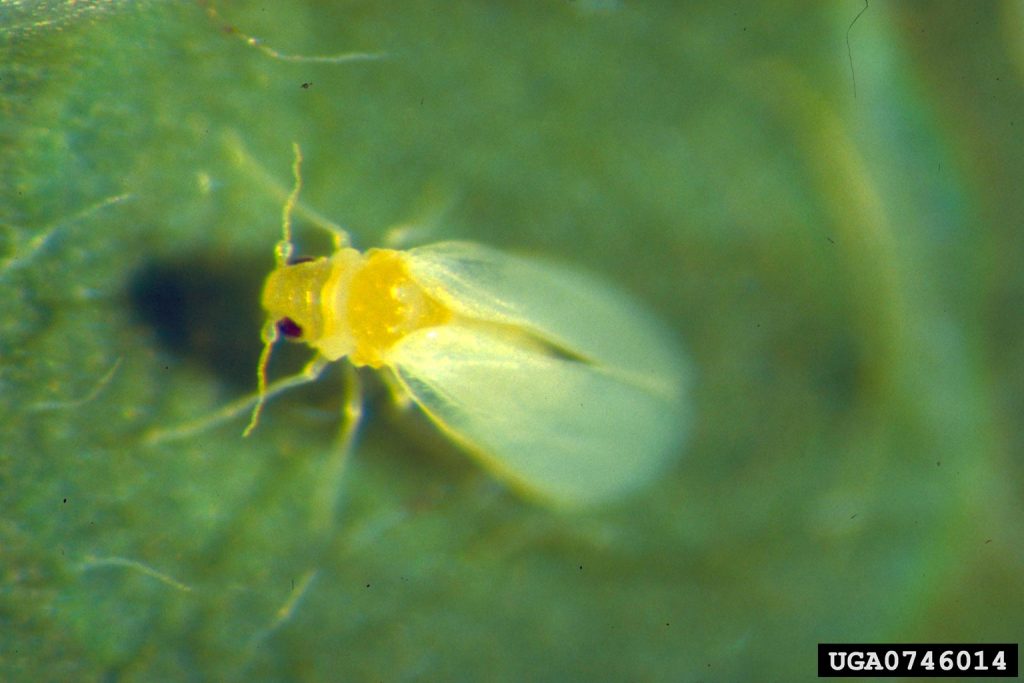
As already mentioned, these insects are very damaging to crops. By feeding on large quantities of sap, they lead to physiological changes in the host plants, resulting in growth delays or other symptoms. Excess sap sugars are secreted in the form of honeydew, which can cause further damage if placed on plant fruits, for example, by making them sticky and promoting the growth of fungal colonies. The leaves also receive numerous stings and, in some cases, may wilt, which can affect the development of the whole plant. As mentioned above, B. tabaci is also a vector for numerous viruses.
Most of the plants on which the whitefly feeds contain phenolic glycosides, and finding out how B. tabaci deals with these defensive metabolites could help to explain its high adaptability to the host.
Is gene transfer from plants to insects possible? The Cell study
This is where the study recently published in Cell comes in handy. Genomic analyses have shown that B. tabaci carries a gene of plant origin, called BtPMaT1, which is involved in the malonyltransferase of phenolic glucosides. The analyses showed that this gene was acquired horizontally from plants (Figure 2). The presence of BtPMaT1 allows B. tabaci to neutralise phenolic glycosides from host plants, making these secondary metabolites almost completely harmless.
Several attempts have been made to detect the same gene, without success, in the genome of other insects, including Trialeurodes vaporariorum, the whitefly, which belongs to the same family as B. tabaci (Family: Aleyrodidae). This could indicate that B. tabaci may have evolutionarily acquired the gene after diverging from the genus Trialeurodes. Horizontal gene transfer could therefore be an important driving force for the adaptive evolution of eukaryotes4.

Figure 2: The figure schematically illustrates the acquisition of the BtPMaT1 gene, which enables B. tabaci to neutralise phenolic glycosides from plants. BtPMaT1 is a phenolic glycoside malonyl transferase gene transferred horizontally from plants to B. tabaci. Silencing experiments show that the same gene can be used to control the pest. © Xia et al., 2021
New approaches to scientific research in crop protection
Over millions of years, both plants and insects have often “borrowed” microbial genes to develop defensive or offensive strategies against their natural opponent. Some insects, such as the coffee berry borer, Hypothenemus hampei, have exploited microbial genes to extract more nutrients from the cell walls of hard-to-digest plants. A wild relative of wheat has stolen a fungal gene to fight the head blights, caused by some species of fungi in the Fusarium genus. However, horizontal gene transfer between plants and insects was not known before and it represents a new clue in the selective fight against pathogens.
The search for new methods and solutions to protect plants and crops from harmful organisms is with no doubt of great importance today. Studies like this allow great strides to be made: finding a technique or developing new technology to inhibit the gene mentioned above could make B. tabaci vulnerable to toxins produced by plants, thus providing a potential solution to counteract the great adaptability of this insect and preserve the health of entire crops.
References
- Mierziak J, Kostyn K, Kulma A. Flavonoids as Important Molecules of Plant Interactions with the Environment. Molecules. 2014;19(10):16240-16265. doi:10.3390/molecules191016240
- Onkokesung N, Reichelt M, van Doorn A, Schuurink RC, van Loon JJA, Dicke M. Modulation of flavonoid metabolites in Arabidopsis thaliana through overexpression of the MYB75 transcription factor: role of kaempferol-3,7-dirhamnoside in resistance to the specialist insect herbivore Pieris brassicae. J Exp Bot. 2014;65(8):2203-2217. doi:10.1093/jxb/eru096
- Xia J, Guo Z, Yang Z, et al. Whitefly hijacks a plant detoxification gene that neutralizes plant toxins. Cell. 2021;0(0). doi:10.1016/j.cell.2021.02.014
- Husnik F, McCutcheon JP. Functional horizontal gene transfer from bacteria to eukaryotes. Nat Publ Gr. 2017;16. doi:10.1038/nrmicro.2017.137
Cover image
Pflanzenschutzamt Saarbrücken, Husken-Thimm, Bugwood.org
You may also like this

Europe’s top universities: Where research thrives in 2025

Microbes and Mood: Deciphering the Connection for a Happier You!

Can’t solve a maze? Ask a slime mould!

The neurobiology behind the Christmas spirit
