
by Giuseppe Scarlata, Maria Chiara Rosace, Antonino Napoleone | March 14, 2021.
At the end of 2020, the world finally has started the way of prevention (read more: COVID-19 vaccine options available) to fight against the well-known SARS-CoV-2: the vaccination campaign has begun. Actually, other practices can be also included among the prevention methods used since the dawn of this pandemic: attempts have been made to raise awareness and educate the population on social distancing, the use of facial masks (read more: the truth about facial masks), and hand sanitising gels. It has been experimentally proven that these practices are very effective in reducing the number of infections and limiting the spread of the virus. As a matter of fact, with the intensification of hygiene measures and social distancing, the transmission peaks of SARS-CoV-2 actually declined. And while the health system focus seems nowadays to be on one antagonist only, from a microbiological point of view we cannot assume that all the other pathogenic microorganisms have suddenly disappeared or gone out of the game. SARS-CoV-2 is not the only viral agent affected by the hygiene and social distancing practices adopted by the population. Prior to the global spread of SARS-CoV-2, especially in the winter seasons when temperatures drop, people often needed to stay at home due to symptoms such as fever, cough, headache, bone pain, and fatigue, which are generally associated with the common flu. For a large portion of the population considered to be at risk, such as pregnant women, children between 6 months and 5 years old, people with chronic respiratory diseases or diabetics, symptoms may worsen to the point of more seriously affecting the cardiovascular and nervous systems. Although further evaluations and studies are needed, at the epidemiological level, there has been a marked decrease in the number of cases of influenza virus infections detected among the population, and we can assume that the preventive practices adopted to limit the spread of SARS-CoV-2 have also been effective in limiting the transmission of influenza viruses, which are airborne transmitted. Which are the pathogens causing flu? How are patients treated? And above all, has there really been a drop in influenza incidence during the COVID-19 pandemic?
Influenza virus features
Influenza is an acute respiratory disease caused by viruses belonging to the Orthomyxoviridae family, which is characterized by the presence of a single-stranded negative-polarity RNA genome that is multi-segmented according to conventional virus classification (e.g. the genome of Coronavirus, belonging to the Coronaviridae family, consists of a single-stranded positive-polarity RNA). Four different strains can infect vertebrates: Influenzavirus A causes infections in humans, mammals, and birds; Influenzavirus B infects humans and pinnipeds; Influenzavirus C infects humans and pigs, and Influenzavirus D infects pigs and cattle. The A and B strains are certainly the most common and the most clinically relevant, compared to the C and D, although inter-human transmission of the latter is not yet well known. The structure shown in Figure 1 relates to Influenza A viruses, which shares many structural similarities with the others. The Influenza A virion is 80-120 nm in diameter and generally spherical in shape. The genome contains eight portions of RNA encoding 11 proteins (HA, NA, NP, M1, M2, NS1, NEP, PA, PB1, PB1-F2, PB2). The most characterised of these are haemagglutinin and neuraminidase, which are found on the outer surface of viral particles. Neuraminidase is an enzyme involved in the release of virions outside infected cells, while haemagglutinin is a protein (lectin) that mediates virus penetration and entry of the viral genome into target human cells.

The routes of transmission are the same as for Coronaviruses:
- Airborne via droplets produced by coughing or talking.
- Direct contact by simply touching the eyes, mouth, or nose with contaminated hands.
- Contact with contaminated common objects, on which the virus can persist for some time, and subsequent contact with the mucous membranes (eyes, nose, mouth).
A person might be infectious from 1-2 days before the onset of symptoms, up to a maximum of 5-10 days after. An additional problem is the presence of asymptomatic carriers, whose rate of infection is more difficult to determine. Treatment is generally aimed at simply relieving the symptoms through analgesic, antipyretic or anti-inflammatory drugs such as paracetamol and ibuprofen. Targeted drug therapy, including M2 protein inhibitors and viral neuraminidase inhibitors, is used for those considered as vulnerable groups or at risk of developing worse symptoms.
Influenza virus incidence in Italy
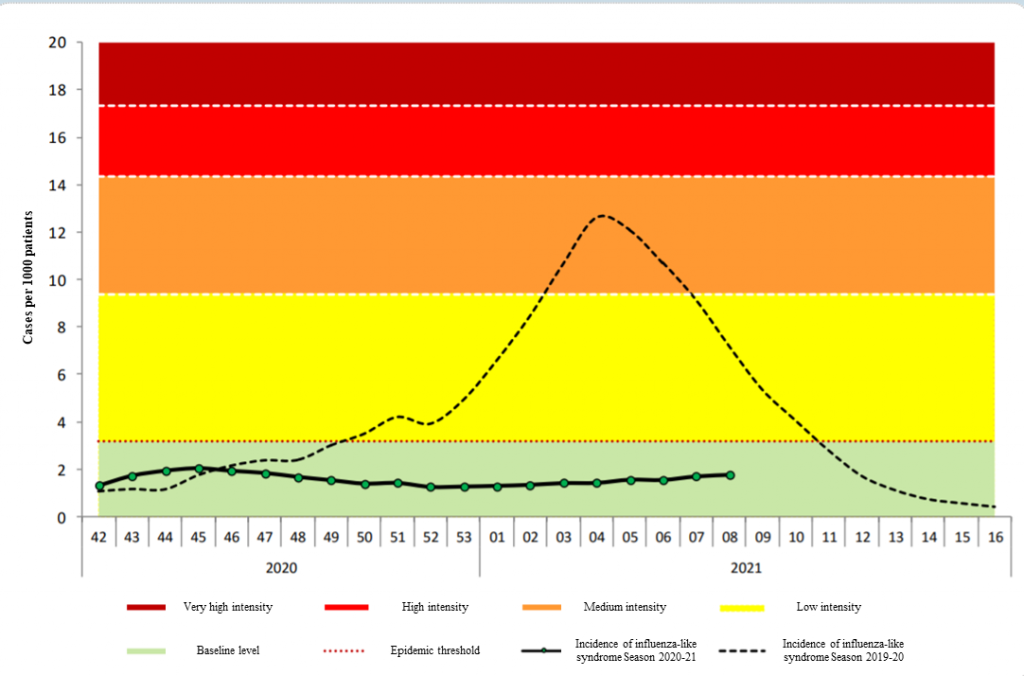
Epidemiological surveillance of influenza in Italy is managed by the Istituto Superiore di Sanità (the National Institute of Health) through the InfluNet platform, which is constantly updated through periodical reports. In the eighth week of 2021, i.e., the one from 22 to 28 February, the incidence of influenza-like syndromes was stable below the baseline of 3.16 cases per thousand assisted, with a recorded value of 1.7 cases. Compared with the previous season, in the same week, the epidemiological curve began its descent after reaching the seasonal epidemic peak, with an incidence of 7.2 cases per thousand assisted (Figure 2).
Analysing the demographic data, the incidence by age group is distributed as follows:
- 0-4 years: 4.448 cases per thousand assisted
- 5-14 years: 1.88 cases per thousand assisted
- 15-64 years of age: 1.77 cases per thousand assisted
- > 65 years old: 0.90 cases per thousand assisted
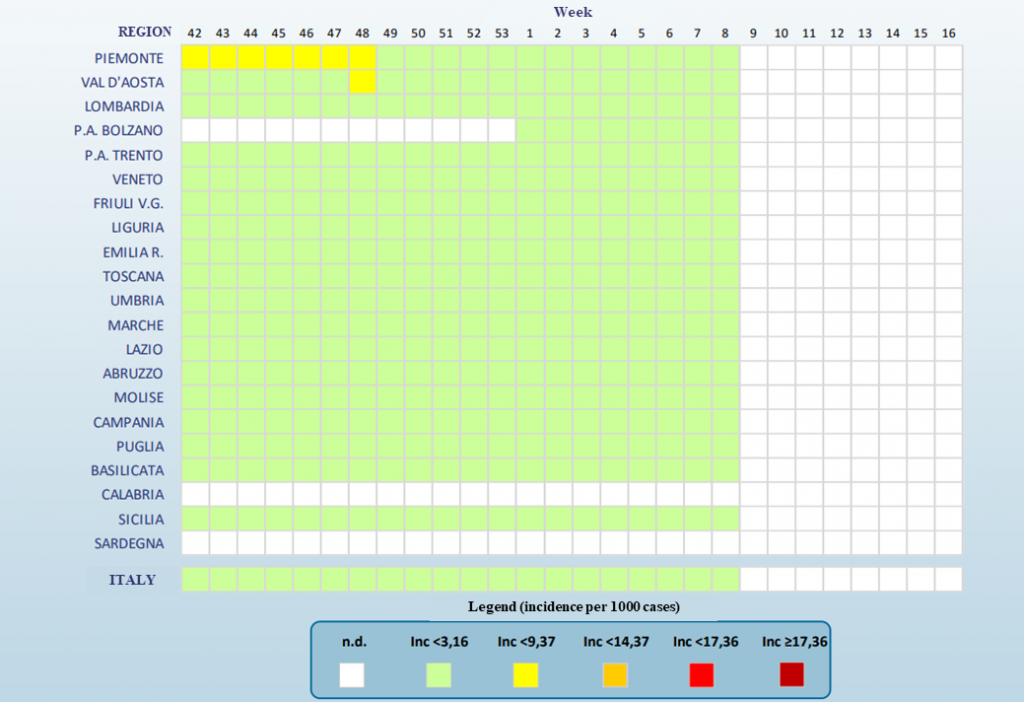
With the exception of the autonomous Province of Bolzano, Calabria and Sardinia, the other regions have activated the surveillance, collecting data and reporting epidemiological findings that confirm an ongoing positive trend of declining influenza incidence among the population (Figure 3).
Conclusions
After analysing the data from the Italian regions that are performing epidemiological surveillance, it seems that preventive measures against SARS-CoV-2 have actually contributed to the reduction of the incidence of common influenza and flu-like syndromes by limiting their transmission below the expected baseline. This phenomenon has in fact been found to be quite comparable globally in different areas. Epidemiological data reported by the scientific community have shown a clear decrease in the incidence rate of influenza and other flu-like respiratory infections in other geographical areas as well (Decreased Influenza Activity During the COVID-19 Pandemic — United States, Australia, Chile, and South Africa).
Certainly, a great appreciation goes to all those people who chose to vaccinate against the influenza virus, indirectly favouring a differential diagnosis with regard to cases of COVID-19 compared to cases of seasonal flu. It is also good to reward those who, with a great sense of responsibility, observe the correct rules of hygiene, social distancing, and the use of masks on a daily basis, clearly demonstrating that the preventive measures in place lead to concrete and effective results in order to limit the transmissibility of a list of other pathogens, from which we would gladly stay far away. Hopefully, soon the active prophylaxis with the large-scale distribution of vaccines can avert at least one of those pathogens on the list. We share the faith in medical sciences rather than the media, hoping that we will soon be able to really think of SARS-CoV-2 as one of the passenger flu viruses.
References
- Luo M. Influenza virus entry. Adv Exp Med Biol. 2012;726:201-221. doi:10.1007/978-1-4614-0980-9_9
- Taubenberger JK, Kash JC. Influenza virus evolution, host adaptation, and pandemic formation. Cell Host Microbe. 2010;7(6):440-451. doi:10.1016/j.chom.2010.05.009
- https://www.epicentro.iss.it/influenza/influenza
- Rapporto Epidemiologico InfluNet n°15 del 5 Marzo 2021.
- Ghedin E, Sengamalay N, Shumway M, Zaborsky J, et al. Large-scale sequencing of human influenza reveals the dynamic nature of viral genome evolution., Nature, vol. 437, n. 7062, Oct 20, 2005, pp. 1162-6.
- Olsen SJ, Azziz-Baumgartner E, Budd AP, et al. Decreased Influenza Activity During the COVID-19 Pandemic — United States, Australia, Chile, and South Africa, 2020. MMWR Morb Mortal Wkly Rep 2020;69:1305–1309. DOI: http://dx.doi.org/10.15585/mmwr.mm6937a6
You may also like this

Europe’s top universities: Where research thrives in 2025

Microbes and Mood: Deciphering the Connection for a Happier You!

Can’t solve a maze? Ask a slime mould!

The neurobiology behind the Christmas spirit
