
by Caterina Campese1 | February 19, 2020
1 Agronomist
Origin and botanical classification
Artocarpus heterophyllus Lam (Figure 1) is a tropical tree species belonging to the Moraceae family. Its common English name is jackfruit, jaca in Portuguese, giaca in Italian. The species was first described by Jean-Baptiste de Lamarck (1744-1829), the French ‘Linnaeus’, who lived in Paris during the Seven Years’ War. In fact, it is believed that the species became known in Europe thanks to the French fleets sailing to Martinique, French Antilles.

Modern scientific literature, starting with Julia Morton (1912- 1996), describes the species as native to the rainforests of the Western Ghati Mountains: the longest mountain range in southern India, running almost entirely through the Deccan Plain on the shore of the Arabian Sea. In natural habitats the species can reach up to ten metres. It is an evergreen, alternate-leaved plant and its leaves are 20 cm long, fleshy and oblong-shaped. All parts of the tree contain latex. The young fruiting branches tend to be grouped in the lower part of the trunk. This natural arrangement makes it easier to pick the fruit, even though the process can be difficult due to its large size.
The fruit develops from the female inflorescence, which consists of a cluster of small flowers. It is a multiple fruit that can reach a considerable size, normally weighing between 2 and 20 kg (Figure 2).
The tomentose peel of the multiple fruit varies in color from yellow to green at maturity and is composed of numerous slightly pointed micro-cones that form an inhospitable surface to insects and pathogens. On the central axis of the multifruit, also rich in latex, the real fruitlets are placed. The flesh of these tiny fruits has a characteristic deep yellow colour and a taste reminiscent of a mixture of banana and pineapple. Each little fruit contains a smooth, light brown oval seed with a whitish inside.

Olfactory jarring note: the ripe fruit emits “a strong smell of rotten onions”, as the botanist Julia Morton1 described it. Once opened, the fruit reveals smells of pineapple, banana and apple.
Nutritional values and dietary properties
Jackfruit can be eaten as fruit, i.e. the fruitlets within the infructescence, as well as the seeds, the leaves and the flowers.
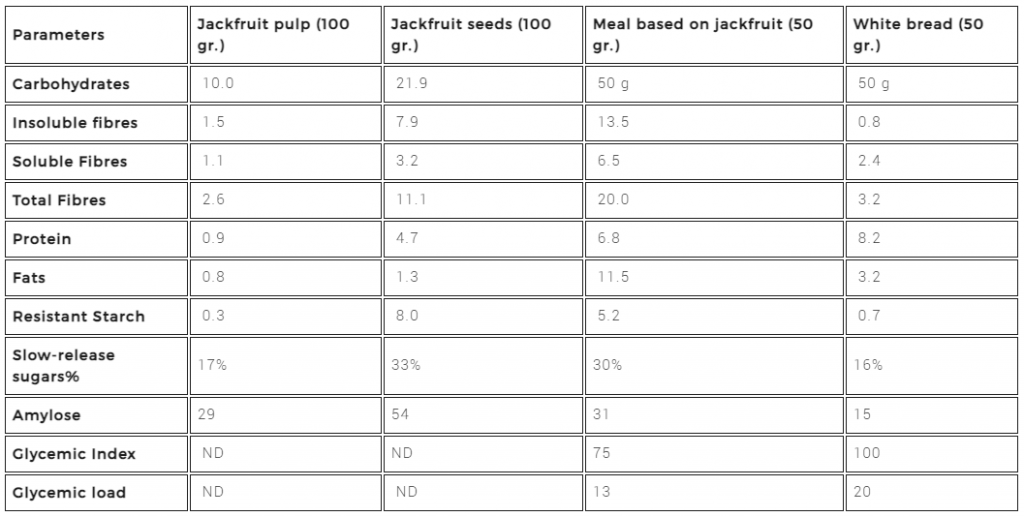
The values in Table 1 show the nutritional parameters per 100 grams of fresh weight of jackfruit pulp (column 1) and its seeds (column 2), of 50 grams of a jackfruit meal (as follows: boiled jackfruit pulp 400 g, jackfruit seeds ~ 50 g, grated coconut 25 g, sambola onion 10 g) (column 3) and of a simple slice of white bread (column 4).
Fresh jackfruit is a good source of carbohydrates, rich in vitamin A and provides sufficient protein (Table 1). The seeds are rich in fibre and provide considerable protein, and are often processed as flour. A jackfruit meal therefore provides a rich and balanced nutritional intake due to its high protein and fibre content. In general, jackfruit appears to have balanced nutritional parameters and a moderate glycaemic index.
Already in 2016, the Wall Street Journal2 identified this fruit as the most potential meaty substitutes, as it is rich in protein and ready to eat without any treatment or processing.
Table 1: Nutritional values of jackfruit pulp and seeds, of a jackfruit meal. White bread is shown for comparison (Hettiaratchi et al. 2011)3. The jackfruit meal is made as follows: boiled jackfruit pulp 400 g, jackfruit seeds ~ 50 g, grated coconut 25 g, sambola onion 10 g
The dietary and healthy characteristics of the fruit include proven anti-inflammatory properties4.
The antioxidant properties of the leaves, both ripe (richer in polyphenols) and senescent (richer in flavonoids), have been ascertained and recognised in several scientific publications. The World Journal of Pharmacy and Pharmaceutical Sciences in 20155 found decent percentages of polyphenols and flavonoids in seed flours as well. A 2015 study from the University of Nairobi, Kenya, published in the African Journal of Biothecnology6, further investigated the content of saturated and unsaturated fatty acids in jackfruit seeds. In particular, the content of omega-3 and omega-6 fats, is comparable to those quantities found in a diet rich in fish.
The International Journal of Life Sciences Biotechnology and Pharma Research reported in 20147 that both jackfruit pulp and waste can be activated with methanol and used to produce citric acid.
Other applications of jackfruit
Jackfruit has many non-food uses. The latex, which is abundant throughout the plant, is used by some populations as a cementing agent, in the manufacture of earthenware and porcelain, as well as in bird trapping. It has also been shown to have a bactericidal effect. Its future use in the production of bio-based plastics could be envisaged. The wood from the plant, which is already exported to Europe, is considered to be of a higher quality than normal teak wood (which is already a valuable material). It is used in the construction sector, in the nautical sector for its excellent resistance to fresh and brackish water, and it is historically used in Asia for the production of fine musical instruments and carved works of art. The leaves are studied as effective in absorbing methylene blue in industrial production. In addition, the leaves and their ashes are also used in the purification of water from toxic compounds and heavy metals, such as cadmium, arsenic and mercury4.
In agriculture, the plant is used as a natural barrier to sun and wind in the cultivation of coffee, pepper, vanilla, betel nut, cocoa, cardamom, and as an intercrop for mango, coconut, or durian.
General considerations
Considering the increase in global temperature8, an interesting question to ask is whether this multifunctional species, of tropical origin, will be integrated among the crops of Mediterranean and temperate areas, as it has already happened with avocado in Greece, Italy and Spain.
An example of how humans and nature are able to adapt to change, for better or for worse, is provided by the Sicilian company Cupitur based in Caronia, in the province of Messina (Figure 3). Pietro Cuccio, managerand founder of this agricultural business, has turned the Sicilian area, which overlooks the sea, into an exotic garden where he grows mangoes, avocados, lychees and even jackfruit. Its products are distributed fresh throughout Europe.

Despite on one hand it is important to limit the anthropic influence on natural processes and environments, on the other hand it is likewise important to be able to seize the new opportunities they offer. After all, if man is not one of the strongest (albeit overbearing) species, he is certainly one of the most resilient. Humans’ peaceful coexistence on Earth lies, possibly, once again in his ability to adapt.
How long will it take for us to adapt to the presence of jackfruit on our tables?
Bibliografia
- Morton JF. The Jackfruit (Artocarpus heterophyllus Lam.): its culture, varieties and utilization. Florida State Hortic Soc. Published online 1965:336-344. Accessed February 16, 2021. https://journals.flvc.org/fshs/article/download/100549/96504
- Jargon J, Gasparro A. The Next Hot Trends in Food – WSJ. The Wall Street Journal. Published October 2016. Accessed February 16, 2021. https://www.wsj.com/articles/the-next-hot-trends-in-food-1476670682
- Hettiaratchi UP, Ekanayake S, Welihinda J. Nutritional assessment of a jackfruit (Artocarpus heterophyllus) meal. Ceylon Med J. 2011;56(2):54-58. doi:10.4038/cmj.v56i2.3109
- Baliga MS, Shivashankara AR, Haniadka R, Dsouza J, Bhat HP. Phytochemistry, nutritional and pharmacological properties of Artocarpus heterophyllus Lam (jackfruit): A review. Food Res Int. 2011;44(7):1800-1811. doi:10.1016/j.foodres.2011.02.035
- Gokhale M, Toro S, Patwardhan M. Evaluation of antioxidant potential of jackfruit (Artocarpus heterophyllus Lam.). World J Pharm Pharm Sci. 2015;4(2):763-765. Accessed February 16, 2021.
- Ojwang R, Runo S, Ben M, Ogoyi D. Lipid profile and levels of omega-3 polyunsaturated fatty acids present in jackfruit ( Artocarpus heterophyllus ) Lam. (Moraceae) seeds and variation in different treatments | African Journal of Biotechnology. African J Biotechnol. 2015;14(16):1409-1417. Accessed February 16, 2021. https://www.ajol.info/index.php/ajb/article/view/117915
- Sashi Prabha M, Subba Rangaiah G. Citric Acid Production Using Artocarpus Heterophyllus and Its Waste with Alcohol as a Stimulant. Int J Life Sci Biotechnol Pharma Res. 2014;3(4). Accessed February 16, 2021. http://www.ijlbpr.com/index.php?m=content&c=index&a=show&catid=125&id=345
- IPPC. AR5 Synthesis Report: Climate Change 2014 — IPCC. Published 2014. Accessed February 16, 2021. https://www.ipcc.ch/report/ar5/syr/
You may also like this

Europe’s top universities: Where research thrives in 2025

Microbes and Mood: Deciphering the Connection for a Happier You!
Can’t solve a maze? Ask a slime mould!

The neurobiology behind the Christmas spirit
