
by Maria Chiara Rosace, Giuseppe Scarlata, Antonino Napoleone | February 12, 2021.
Within the so different food sphere, some people approach to novelties showing curiosity, some others feel aversion or repulsion and others instead are willing to include new food into their diet. Beyond any personal preference and taste, there is a real possibility that entomophagy, i.e. the consumption of edible insects, will soon represent a valid alternative to traditional diets, not only from a nutritional point of view, but also for its environmental sustainability. European consumers are not used to think of insects as such, but they are already an important food source in many cultures around the world and for billions of people. Their consumption is widely spread in Thailand, China, Mexico, Korea, but also in Australia, New Zealand and, since 2017, in Switzerland, and it is not unlikely that also within the European Union we will soon be able to buy and eat insects. As a matter of fact, the European Food Safety Authority (EFSA) has recently published its first completed assessment of a proposed insect-derived food product1: the dried yellow mealworm (Tenebrio molitor larvae).
Tenebrio molitor and nutritional values
Starting from 2018, following the entry into force of Regulation (EU) 2015/22832, the rules for the introduction and sale of Novel Foods in the European Union have changed drastically. In order for a new product, including insects, to be included in the list of authorised Novel Foods, its safety must be assessed by EFSA and authorised by the European Commission. As already mentioned, just this year, EFSA has published the first scientific opinion on the safety of the insect larvae Tenebrio molitor, as a novel food.
T. monitor, the yellow mealworm, is a species of insect belonging to the family Tenebrionidae. Thermally dried larvae (Figure 1) are proposed as an ingredient in various food products, such as energy bars, pasta and biscuits, as whole, dried insect or in the form of powder.

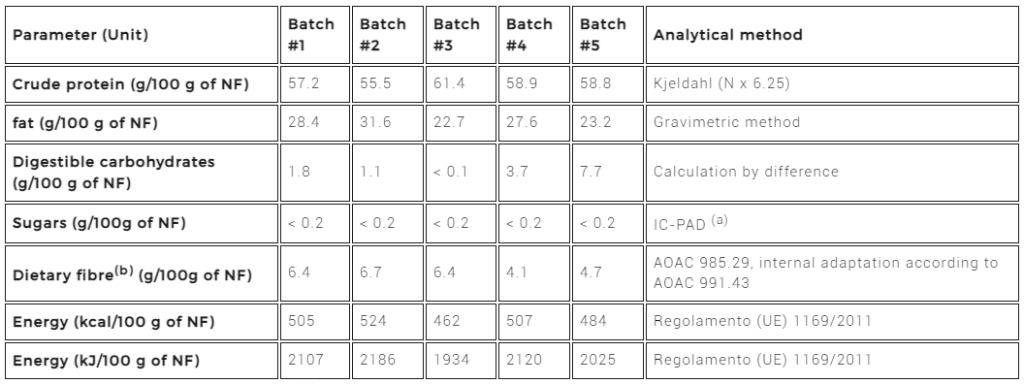
Larvae consist mainly of protein, fat and fiber, including chitin, the main component of the insects’ exoskeleton. They have a high protein content (equal to 58.4 g of raw protein per 100 g), which could be partly overestimated due to the nitrogen-protein conversion factor used (protein content would drop by 24% using a different conversion factor3, reaching 44.5 g/100 g), as well as a higher amino acid content compared to food products such as barley, fish, brewer’s yeast, beef, crustaceans. From a nutritional point of view, it seems that the consumption of T. molitor larvae does not cause any negative effect on human health. Additional nutritional parameters are shown in Table 1.
Table 1: Proximate analysis of Tenebrio molitor and nutritional parameters. NF = Novel Food. Adapted from EFSA NDA Panel (2021)
(b): Chitin is the main form of dietary fibre in the NF; AOAC: Association of Official Agricultural Chemists
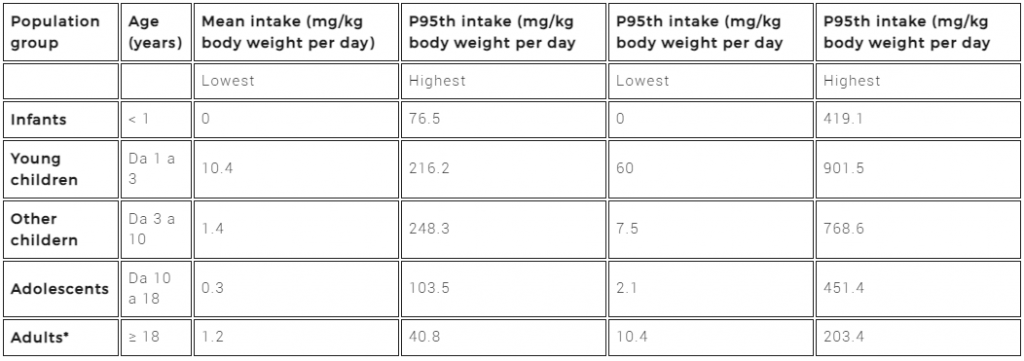
EFSA included in its opinion a table showing the anticipated daily intake of this new ingredient for each population category, from infants and children to adults, including elderly (Table 2).
Table 2: Intake estimates resulting from the use of the Novel Food (NF) as an ingredient in the intended food categories at the maximum proposed use levels. Adapted from EFSA NDA Panel (2021)
Safety of this novel food
It is widely known that some insect species secrete chemical substances with potentially toxic effects, as part of their defense mechanisms. Furthermore, some food allergies are linked to allergens of protein origin and we have just learned that Tenebrio molitor larvae have a high protein content. Is it therefore safe for human health to eat these insects?
It is true that T. molitor adult beatles secrete organic substances, such as benzoquinones, that can have toxic effects. However, these substances are not secreted by the larvae, which use other defense mechanisms and no adverse effects have been observed in toxicological studies available in the literature.
According to the experts’ opinion, the risk linked to the possible presence of contaminants in the larvae or in their derivatives, would largely depend on the feed substrate used to rear the yellow mealworm. In terms of safety, toxicity studies have not revealed any concerns. However, possible allergic reactions to the proteins cannot be excluded for particularly susceptible individuals. In particular, within arthropods, several allergens have been reported, including tropomyosin, arginine kinase, and glutathione S-transferase. In addition, chitinases, enzymes that degrade chitin, have been identified as allergens present in some insect species. An additional source of potential allergens could come from feed substrate used to feed the larvae.
New opportunities for a sustainable future
Feeding the world’s growing population with increasingly demanding consumers will necessarily require an increase in food production. Demand for meat products is expected to increase by more than 75% from current levels in 2050 due to population growth. This will inevitably place severe pressure on already limited resources such as fertiliser, water, energy, and soil4 (for additional information: protect our soil to preserve food safety). Finding sustainable dietary protein alternatives is a pressing need, and those provided by entomophagy could be the solution. Insects are in fact an extremely sustainable source of protein, and raising them offers numerous advantages5, including:
- Reduced soil use;
- Reduced need for water;
- Lower greenhouse gas emissions into the atmosphere;
- Need for little space and few resources to set up a farm;
- Transformation of low-value organic by-products into high-quality food or feed;
- High reproduction rate (e.g., a female T. molitor produces over 150 eggs in her lifetime – approx. 3 months – and their maturation period is very short);
- Higher efficiency of food conversion;
- Lower risk of transmission of zoonotic infections to humans;
- Significantly lower breeding costs.
Insects are therefore an important available resource and their breeding would certainly lead to a lower exploitation of environmental resources, with many advantages in terms of sustainability. Further scientific data are however necessary to draw more certain conclusions.
Conclusions: don’t worry, it’s safe to eat!
Following the evaluations and scientific studies analysed, EFSA opinion concludes that the use of Tenebrio molitor larvae is safe under the proposed uses and use levels. The door has finally been opened in Europe for the consumption of insects, even if the European Commission and the Member States will first need to provide their approval before the yellow mealworm can actually be commercialised. The consumption of insects would lead to countless environmental and economic benefits, but consumer acceptance remains one of the biggest barriers to their potential use on a large scale. The reason why many people feel an aversion to certain foods is not related to their taste or goodness, but rather to cultural reasons. Even entomophagy could therefore slowly catch on, starting with proper education and outreach.
References
1. EFSA Panel on Nutrition, Turck D, Castenmiller J, et al. Safety of dried yellow mealworm (Tenebrio molitor larva) as a novel food pursuant to Regulation (EU) 2015/2283. EFSA J. 2021;19(1). doi:10.2903/j.efsa.2021.6343
2. Regulation (EU) 2015/2283 of the European Parliament and of the Council of 25 November 2015 on novel foods, amending Regulation (EU) No 1169/2011 of the European Parliament and of the Council and repealing Regulation (EC) No 258/97 of the European Parliament and of the Council and Commission Regulation (EC) No 1852/2001 (Text with EEA relevance) OJ L 327, 11.12.2015, p. 1–22
3. Janssen RH, Vincken JP, Van Den Broek LAM, Fogliano V, Lakemond CMM. Nitrogen-to-Protein Conversion Factors for Three Edible Insects: Tenebrio molitor, Alphitobius diaperinus, and Hermetia illucens. J Agric Food Chem. 2017;65(11):2275-2278. doi:10.1021/acs.jafc.7b00471
4. Fao, Arnold van Huis, Joost Van Itterbeeck, et al. Edible Insects – Future Prospects for Food and Feed Security.; 2013.
5. van Huis A, Oonincx DGAB. The environmental sustainability of insects as food and feed. A review. Agron Sustain Dev. 2017;37(5):1-14. doi:10.1007/s13593-017-0452-8
You may also like this

Europe’s top universities: Where research thrives in 2025
Microbes and Mood: Deciphering the Connection for a Happier You!
Can’t solve a maze? Ask a slime mould!

The neurobiology behind the Christmas spirit
