
by Maurizio Bazzucchi (Internist at the Civil Hospital in Pescara, Italy) | 24 May 2020
Introduction
Due to possible and frequent genetic mutations of the various Coronavirus strains, which has made expensive and difficult to identify an effective vaccine for SARS and MERS, it will be very difficult to develop one for SARS-CoV-2. Any modifications of the antigenic site of the surface proteins, especially in the Spikes proteins (through which the virus attacks the target cell), is equivalent to a new viral strain1,2. In this way the antibodies production against the mutated variant could be vain3. A wide range of antiviral strategies have been proposed, including inhibition of viral entry in the cell and replication4.
How does the virus enter the human cells?
SARS-CoV-2 uses the ACE2 receptor to infect human cells. The Spike protein of the virus consists of two subunits, S1 and S2. Once S1 binds the receptor binding domain (RBD) of the ACE2 receptor to the target cell, the HR1 and HR2 domains of the S2 receptor subunit bring the cell and virus membranes closer together to facilitate fusion and thus lead to viral penetration. It has been seen that two Spikes bind two ACE2 receptors simultaneously. Once the binding of the Spikes to the ACE2 receptor have happened, some enzymes, the serine proteases TMPRSS and Furin, make possible a conformational modification of the S2 subunit. This modification allows an easy penetration of the virus into the host cell.
Both endothelial cells, constituents of blood vessels, and a particular subtype of lung cells, type II pneumocytes, express high concentrations of ACE2 and TMPRSS. The “cleavage” performed by Furin does not occur for all other coronaviruses and allows a 1000 times higher transmissibility and penetration of SARS-CoV-2 than for the SARS-responsible coronavirus. Moreover, since Furin is a systemic serine protease involved in many physiological functions, this protein allows an equally systemic viral spread. For this reason all the specific inhibitors of Furin have multiple and serious adverse effects.
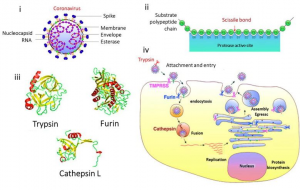
Figure 1. Entry into the cell by SARS-CoV-2
The potential weapons to be employed against the virus can be divided into: 1) Spike-ACE2 receptor binding inhibitors; 2) Anti-serine protease molecules; 3) ACE2 receptor S2 subunit HR1 domain inhibitors; 4) Inhibitors of viral enzymes essential for replication, the so-called antiviral drugs.
Spikes-ACE2 receptor binding inhibitors
Which molecules could inhibit the binding of the viral Spike to the ACE2 receptor? (Figure 2)
a) Soluble fragment of RBD (Receptor Binding Domain): it prevents Spike-ACE2 receptor binding through competitive binding to the ACE2 receptor;
b) Soluble fragment of the Spike protein: it “sequesters” the ACE2 receptor and it does not allow the Spike protein of the virus to attach on it through competitive binding to the ACE2 receptor;
c) ACE2 receptor soluble fragments: they directly bind the viral Spike protein. In this way they block the viral Spike protein binding to the ACE2 receptors.
The scientists are working on these three options by searching for specific monoclonal antibodies to target the proteins mentioned above.
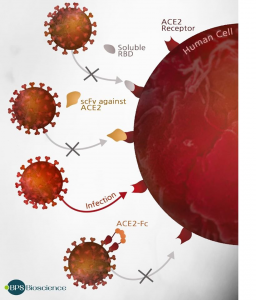
Figure 2. From top to bottom: a) soluble fragment of RBD (ReceptorBindingDomain); b) soluble fragment of the Spike protein that binds the ACE2 receptor preventing binding of the virus Spike to the ACE2 receptor; c) soluble fragments of ACE2 receptor that directly bind viral Spikes.
Anti-serine protease molecules
These molecules may inhibit enzymes designed to facilitate entry into the cell by the virus. Among them:
- Camostat and Nafamostat: both derived from an old drug, Aprotinin, used in acute pancreatitis and withdrawn for serious side effects that Camostat and Nafamostat do not seem to have at least for short treatments;
- Gabesate: it has a mild effect on the synthesis of some inflammatory molecules, TNF- α and interleukin-6, as well as having non-specific anticoagulant activity. It needs to be administered early (within 48 hours from the onset of the most relevant symptoms). It is a drug under study in Germany but preliminary data are still missing.
ACE2 receptor S2 subunit HR1 domain inhibitors
It essentially consists of a molecule that could inhibit the HR1 domain of the S2 subunit of the ACE2 receptor. It is EK1C4, a lipopeptide (protein fragment conjugated with cholesterol molecule) that has several advantages in the prevention and treatment of SARS-CoV-25:
- The intranasal (inhalation) route of administration makes EK1C4 a very handy and useful drug in preventing contagion in crowded and, therefore, high-risk environments, also because the drug could be easily transported in a small container;
- This drug could be used in the treatment of patients with COVID in which the virus is actively replicating, reducing both the amount of viral load in the lungs and the possibility for the patient to be a source of infection;
- By acting only locally and not systemically, possible side effects on other organs or systems are reduced. This ensures the safety of the medication even if long periods of administration are required;
- It is a synthetic drug reproducible on a large scale and in a very short time;
- Last but not least is the fact that it can be used for all coronavirus genotypes. The target of EK1C4, i.e. the HR1 domain of S2, is highly conserved (the gene from which it originates, therefore, is not frequently subject to mutations that modify its structure). In this way the HR1 domain would be a stable point of attack for drug therapy. Among the 103 different SARS-COV-2 genomes recently identified, none of them had HR1 or HR2 domain mutations.
Antiviral drugs: use in COVID-19
Antiviral drugs, already in use for diseases such as AIDS and hepatitis C, generally inhibit enzymes or virus molecules essential for entry and/or replication in the host cell. Among them, Remdesevir, Ledipasvir Orvelpatasvir are particularly promising in therapy against SARS-CoV-2 and seem to have minimal side effects while the antivirals Velpatasvir/Sofosbuvir (Epclusa®) and Ledipasvir/Sofosbuvir (Harvoni®) could be based on a rational inhibition on two viral enzymes.
Although these potential weapons against the virus are very promising, further studies are needed to confirm the effectiveness and safety of these molecules.
Bibliography
- Du L. et al. Expert Opinion on Therapeutic Targets, 2017 Feb. 1080/14728222.2017.1271415
- Kleine-Weber H. et al., Ski Rep. 2018 Nov. 1038/s41598-018-34859-w
- Stebbing J. et al. The Lancet Infectious Diseases, 2020. 1016/S1473-3099(20)30132-8
- Peeri N. C. et al., International Journal of Epidemiology, 2020. 1093/ije/dyaa033
- Shuai X. et al., Cell Research, 2020 Mar. 1038/s41422-020-0305-x
You may also like this

Europe’s top universities: Where research thrives in 2025

Microbes and Mood: Deciphering the Connection for a Happier You!

Can’t solve a maze? Ask a slime mould!

The neurobiology behind the Christmas spirit
