
by Giuseppe Scarlata, Antonino Napoleone, Domenico Gangemi | 22 May 2020
The Coronavirus Infectious Disease-19 (COVID-19) pandemic has severely shaken the global geopolitical balance, forcing most governments to make drastic decisions on social interactions, up to total lock-down to limit the number of infections. After months of draconian restrictions, several countries are beginning to approach Phase 2 and Phase 3 of the pandemic relaxing social distancing measures. Recent epidemiological models predict and warn of a possible second wave of cases in conjunction with the relaxing of restrictive measures and the generalized lowering of the population’s guard. The best strategy proposed by scientists to deal with phases 2 and 3 of the pandemic in the safest way, involves the massive testing and large-scale contact tracing apps downloads. Several apps are under development (e.g., the NHS app in the UK, the app developed by the Google-Apple partnership, etc.), others are ready to be released, such as Immuni welcomed in Italy by the Minister for Technological Innovation and Digitization in agreement with the Ministry of Health.
What is contact tracing and why could it be useful against COVID-19?
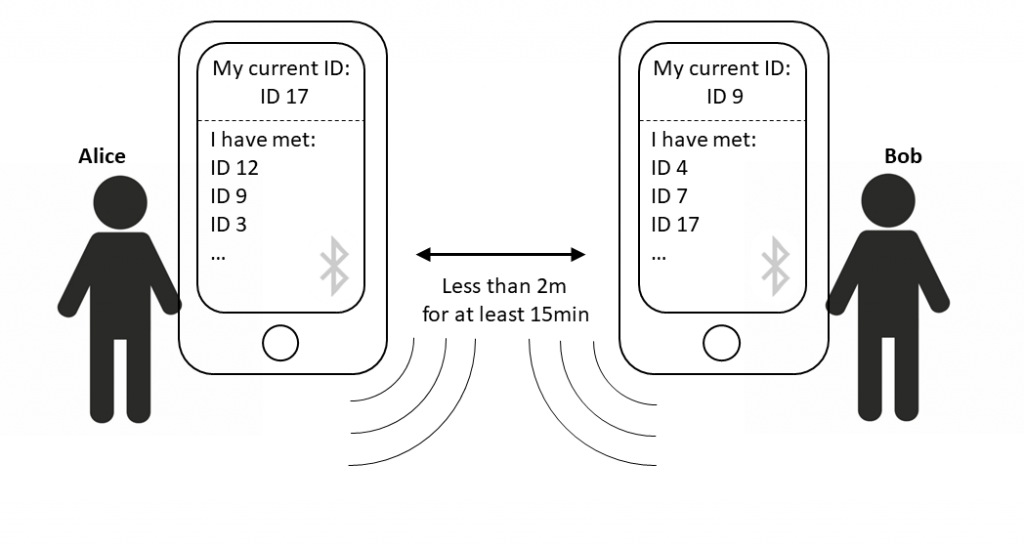
It has been scientifically proven that the virus is also transmitted by pre-symptomatic and asymptomatic individuals. Quarantining only individuals with symptoms may not be enough to contain the number of infections, but all those who come into contact with individuals who tested positive should be quarantined. It has been shown that the risk of infection is higher if individuals are in contact for at least 10-15 minutes with an infected person within a distance of 1.5 to 2 meters (Figure 1.). These parameters serve as a reference setting for contact tracing apps, with the aim of being able to track individuals who have come into contact with infected patients and alert them to the possibility of being infected. If the app will be downloaded on a large scale, it would allow more immediate and efficient identification of individuals to be tested and/or to be self-isolated, avoiding the spread of contagion. According to a statistical model recently presented by the University of Oxford, of about 80% of the population in the UK using a smartphone, at least 56% (about 37 million out of a total of 68 million inhabitants) would need to download the app to make it really effective. This is why it is important to inform and convince people about its value.
Bluetooth technology vs. GPS
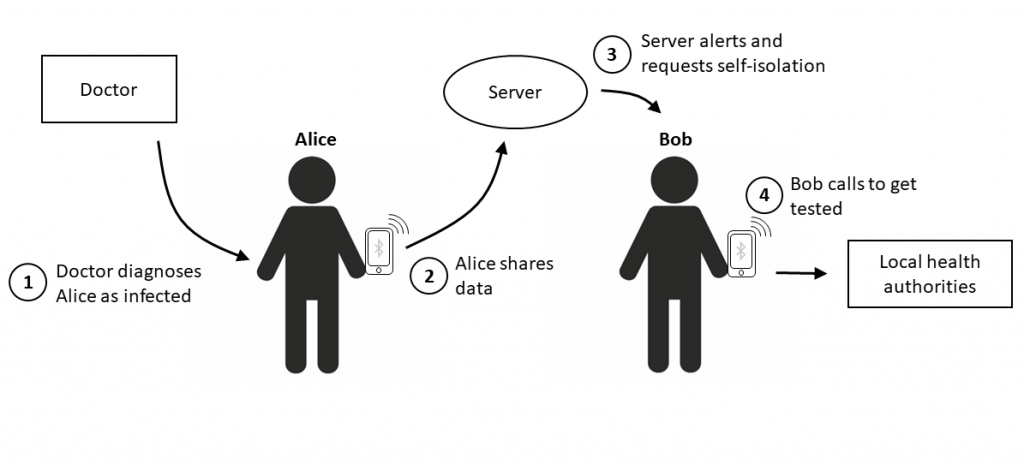
Immuni is a contact tracing app that will be released for free in Italy probably at the end of the month from the App Store and Play Store for iOS and Android, freely available for download. At the first access you just need to enter the domicile, declare that you are over 14 years old, and accept its privacy policy. The application will use Bluetooth technology to track and collect unidirectional signals (beacons) in the presence of two smartphones at a short distance from each other. The first advantage is that it will not be necessary to activate the internet connection, but only the Bluetooth Low-Energy technology, with a net saving of the device’s battery, the second and more relevant is the non-use of GPS to track the user’s movements, in order to totally guarantee the privacy. Immuni generates anonymous codes during close contact with other users, without disclosing personal data or information, but simply by evaluating the distance and time of contact (from 5 to a maximum of 30 minutes). Compared to GPS localization, many drawbacks are solved, for example if the GPS signal is disturbed or the inaccuracy of the localization in buildings with many floors. In case of contact with a positive individual in the area of the app’s Bluetooth signal, a notification is sent to all users based on the anonymous codes generated, indicating which measures to adopt depending on the low, medium, or high contagion risk level. This is supported and coordinated by qualified healthcare workers, who also record COVID-19 positivity on the app to avoid false reports from the users (Figure 2).
Privacy
The technological base of contact tracing through Bluetooth adopted by Immuni is based on Privacy-Preserving Contact Tracing, proposed by Apple and Google in respect of user’s data and information. From an epidemiological point of view, it is not crucial to know the places or movements of users, nor to have or disseminate personal information, but it is sufficient to trace the anonymous codes generated by the app and track individuals who have come into contact with infected patients. It is not possible to trace the personal data or information of individuals who tested positive, as the codes are randomly generated and change periodically. The only data that will be collected and accessed by health authorities concerns the number of notifications sent each day in order to update the statistical data and get an overview of the spread of contagions.
Contact tracing apps in the rest of the world
Which are the contact tracing apps in the rest of the world?
- Trace Together (Singapore): app that works in a similar way to Immuni and is based on the Bluetooth system;
- Corona 100 (South Korea): definitely more invasive as it tracks people’s movements and consequently their last contacts and all their activities;
- Health Code (China): currently the most invasive tool from the point of view of privacy because after tracking every movement of the user, it assigns a code (green, red, yellow) indicating who must be forced to quarantine or can carry out normal daily activities;
- Privacy Kit (Boston): the app uses both Bluetooth and geolocation by tracking the movements and saving them every five minutes only in the personal smartphone storage space;
- Covid Guard (Denmark): one of the youngest apps was created by three Danish students and it uses Bluetooth technology by recording contacts with people for more than two minutes and at a maximum distance of two meters, sending an anonymous notification if one of these contacts tested positive for the new coronavirus and inviting the user to self-isolation.
The collaboration between Apple and Google
To address the pandemic, Google and Apple have also announced a historic partnership to make improvements and support health and government authorities worldwide. Both companies will be launching a comprehensive solution that includes application programming interfaces (APIs) and operating system-level technology to assist in enabling contact tracing and interconnected operations between devices running Android and iOS operating systems. Apple and Google will work also together to optimize Bluetooth technology by increasing contagion tracking capabilities and, above all, to extend connections with more apps also on an international scale. In fact, this would solve one of the current limitations, which concerns international travel that cannot be monitored by national apps. Furthermore, the aim is to increase the number of downloads and the systems for the protection of privacy, transparency, and informed consent of users (Privacy-Preserving Contact Tracing).
Conclusions
There were aversion and criticism, mainly due to the risk that these apps may not fully guarantee users’ privacy. Moreover, there are still many doubts to be clarified, especially on the psychological and social profile, because there are further consequences linked to the extensive use of these apps: what role will the health care staff have in this “cyber web”? How will users in public environments have to react in case of positive risk notification from the app? In work environments, how will employers react with employees? In the most crowded restaurants or shopping malls instead?
The contact tracing app will certainly be useful in tracing and identifying new outbreaks especially in phases 2 and 3 of the pandemic, but it is necessary to ensure that this approach will fully satisfy user confidence and it will be supplemented by a robust and extensive campaign of swabs and diagnostic tests. Furthermore, this pandemic has highlighted the importance that individual responsibility and behavior count more than anything else. These combined factors are the real key to the future management and success of this race against the virus. Share and have faith in medical science rather than the media, we all need to work together to stop all of this.
References:
- https://innovazione.gov.it/un-aggiornamento-sull-applicazione-di-contact-tracing-digitale-per-l-emergenza-coronavirus/
- https://www.wired.it/attualita/tech/2020/04/20/il-contact-tracing-via-app-quale-strategia-usare/
- https://www.marionegri.it/magazine/tracciamento-covid-19?/
- https://www.ispazio.net/1970108/ecco-come-funzionera-immuni-e-quando-sara-disponibile?
- https://www.dtu.dk/english/news/2020/05/students-behind-covid-19-app-win-hackathon?id=6f428ad5-5d0a-43a5-ac75-6d51f18d1071
- Abeler J. et al., JMIR Mhealth Uhealth 2020;8. doi:10.2196/19359.
- https://www.apple.com/newsroom/2020/04/apple-and-google-partner-on-covid-19-contact-tracing-technology/
You may also like this

Europe’s top universities: Where research thrives in 2025

Microbes and Mood: Deciphering the Connection for a Happier You!

Can’t solve a maze? Ask a slime mould!

The neurobiology behind the Christmas spirit
