
by Antonino Napoleone, Giuseppe Scarlata, Domenico Gangemi | June 23, 2020
Research groups led by internationally reputed scientists in Vaccinology and Immunology have accelerated the clinical trial process to develop a safe and effective vaccine against Covid-19 (Coronavirus Infectious Disease 2019). Already by the end of March 2020, public expectations were high and there was speculation on the timing of the launch of a vaccine on the market by the end of the same year. The focus of worldwide research was mainly on possible therapeutic or prophylactic solutions, in a combination of alliances and strategies that led to the parallel collaboration of universities, pharmaceutical companies, and government agencies and the extraordinary and rapid mobilization of substantial resources and funding. Strategic alliances between leading pharmaceutical industries and government institutions are essential to accelerate the development, production, and distribution of an effective and safe vaccine. (more details on the GSK – Sanofi partnership). Currently, more than 100 candidate vaccines against SARS-CoV-2 are being tested and studied, of which 72% are developed by private pharmaceutical companies, both multinational (GSK, Sanofi, Pfizer, AstraZeneca) and medium-sized (Moderna, CanSino Biologicals, Novavax), while the remaining 22% are from universities (Oxford University), government agencies and non-profit organizations (Figure 1).
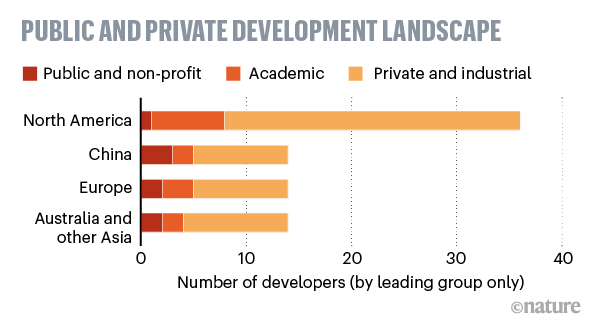
It is not the first time that the world has interfaced with this family of viruses. In fact, the human coronaviruses responsible for the Middle East Respiratory Syndrome (MERS-CoV) and Severe Acute Respiratory Syndrome (SARS-CoV) have given an initial boost to the discovery and development of a potential vaccine, but this has not been followed up due to the lack of investments and the faster containment of infections.
A graphic guide to summarize and explain the technologies used for the design of candidate vaccines against SARS-CoV-2 has been published in the well-known journal Nature.
The technological landscape of SARS-CoV-2 vaccine development
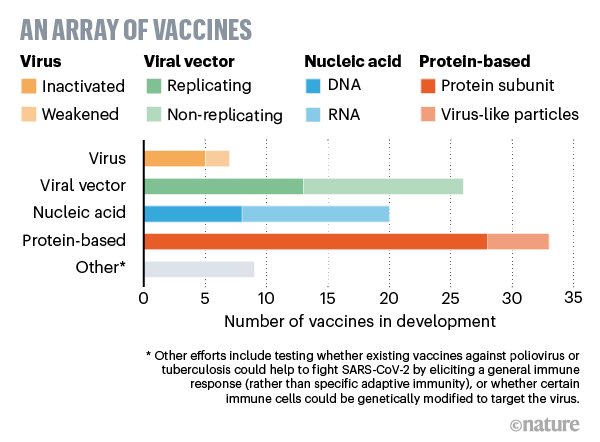
The aim of the vaccine is to expose the body to viral antigens that are treated artificially in order not to cause disease and to trigger an appropriate immune response that will block, eliminate the virus, and prevent a possible infection over time. The vaccine development landscape against SARS-CoV-2 includes technological platforms, some of them are innovative, and others are already tested and applied for older vaccines (Figure 2).
VIRUS VACCINE
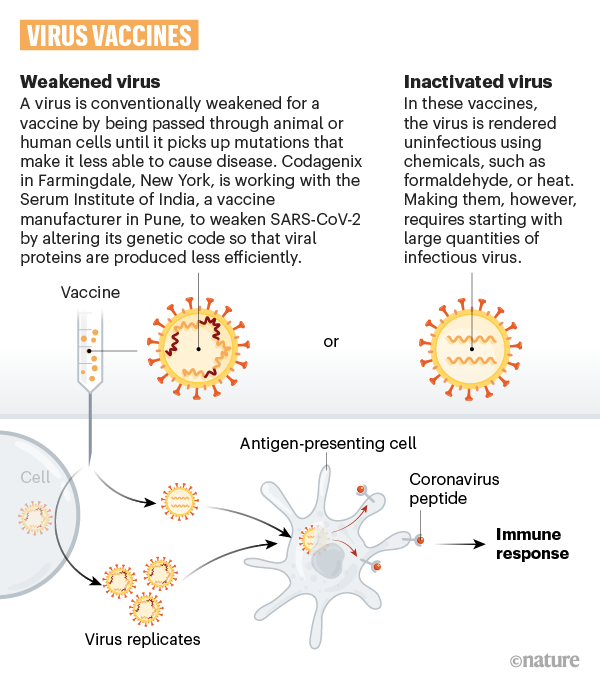
At least seven projects are involved in the development of viral vaccines, using the virus in inactivated or attenuated form. Several existing vaccines have been developed in this way, such as the measles and polio vaccine, but require extensive and varied safety testing (Figure 3).
VIRAL-VECTOR VACCINES
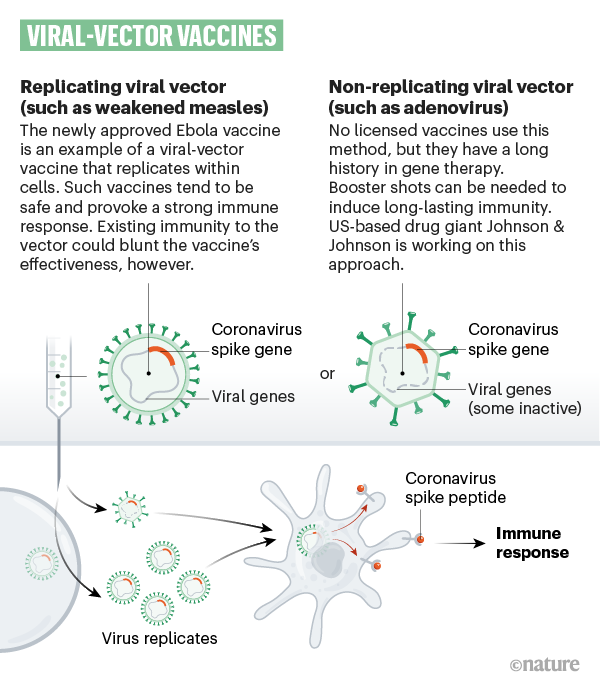
More than twenty research groups are working on viral vector vaccines. This innovative technology involves the use of other viruses (measles virus or adenovirus) modified in the laboratory to deliver coronavirus proteins into the body and trigger a powerful and effective immune response in complete safety (Figure 4). The pharmaceutical giant Johnson & Johnson is investing in this approach, as is the University of Oxford in collaboration with AstraZeneca and IRBM in Pomezia (Italy).
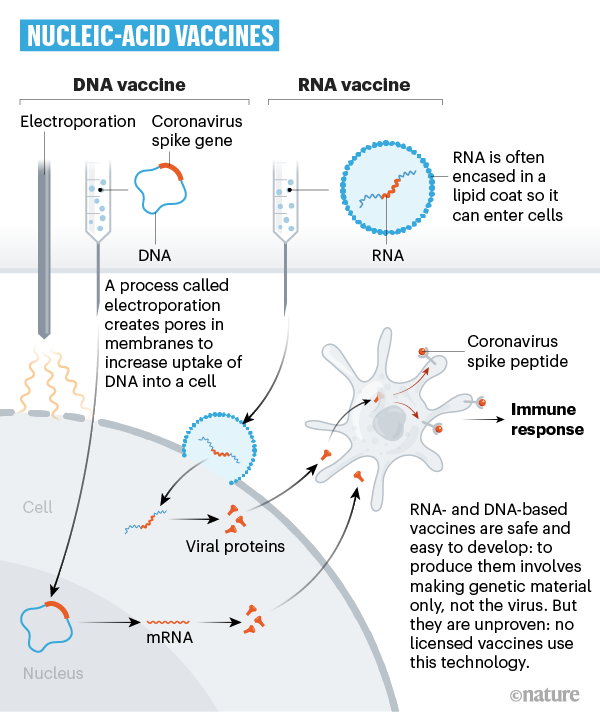
NUCLEI-ACID VACCINES
This technology uses the genetic information contained in DNA or RNA to develop coronavirus proteins that can trigger a powerful immune response. Specific fragments of coronavirus DNA or RNA are selected by scientists and transferred into human cells to produce viral antigens that will act as vaccines Figure 5). More than twenty research groups have focused on this approach, including the US-based company Moderna, which developed an RNA vaccine (mRNA-1273 Vaccine), and Italian biotech companies Takis and Evvivax in collaboration to develop the “Covid-eVax” DNA vaccine.
PROTEIN-BASED VACCINES
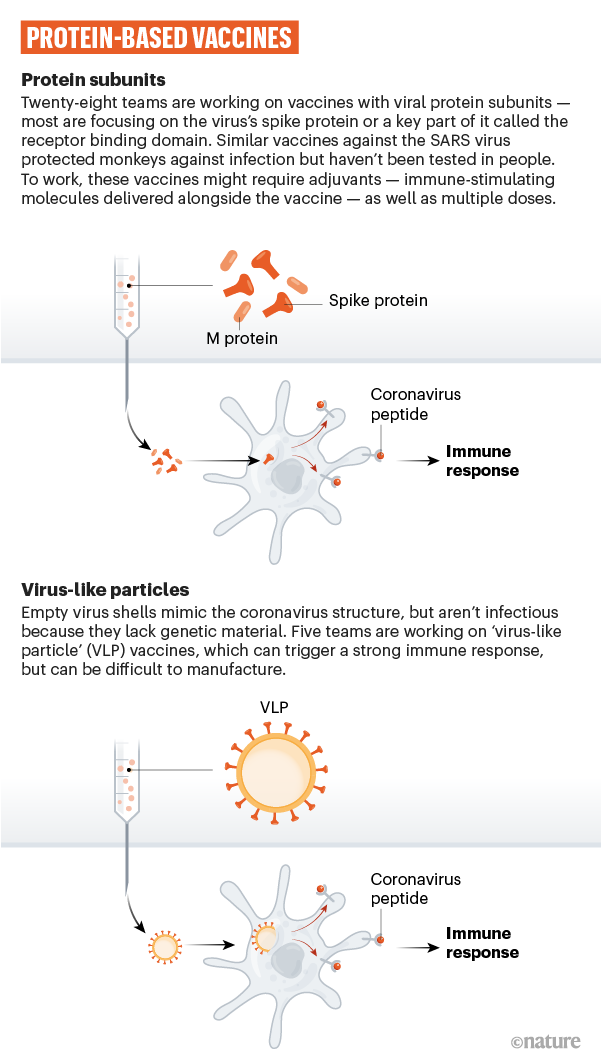
This technological platform consists of injecting Coronavirus proteins directly into the body. The solution of this approach is to use fragments of viral proteins or “emptied protein envelopes”, the virus-like particles that mimic externally the structure of the Coronavirus, being recognized by immune cells as the original virus (Figure 6).
Conclusions
The research and development of a vaccine are complex and structured processes in which there are countless factors to consider, investigate, and test. It is an area in which Immunology, Microbiology, Chemistry, Molecular Biology, and public opinion intertwine in synergy. The latter recently seems to have more impact than any other scientific discipline. The need and importance of having a vaccine as soon as possible will not limit the number of safety tests, nor will shortcuts be found in the protocols and phases of clinical trials planned. The safety/efficacy ratio of a vaccine is based on robust and validated data including both technical/scientific and regulatory evaluations and controls. In the development of a vaccine, safety and efficacy are often inversely related, an improvement in one may result in a loss of performance in the other. Between the two, safety is always given priority over efficacy in regulatory review because the target populations of vaccines are usually healthy. In order to gain time and speed up all phases of testing, until the launch on the market, safety controls will not be reduced but will have to aim to speed up bureaucratic operations, and among all, the pandemic is bringing good feedback making it more agile and “smart”. Now all we have to wait and cross our fingers until we find out which approach and technology will be able to fulfill all the requirements and arrive at the end of the race with a winning vaccine that will be made available on a large scale. Share and have faith in medical sciences rather than the media, we all need to work together to distrust anti-vax.
References
- Thanh Le, T. et al. The COVID-19 vaccine development landscape. Nat. Rev. Drug Discov. 19, 305–306 (2020).
- https://www.scienzainrete.it/articolo/speranza-del-vaccino/roberta-villa/2020-06-15
- Callaway, E. The race for coronavirus vaccines: a graphical guide. Nature 580, 576–577 (2020).
- Kaslow, D. C. Certainty of success: three critical parameters in coronavirus vaccine development. npj Vaccines 5, 1–7 (2020).
- Vetter, V., Denizer, G., Friedland, L. R., Krishnan, J. & Shapiro, M. Understanding modern-day vaccines: what you need to know. Ann. Med. 50, 110–120 (2018).
- Look East for the Future of. 60 (2018).
- Chandler, R. E. Optimizing safety surveillance for COVID-19 vaccines. Nat. Rev. Immunol. (2020) doi:10.1038/s41577-020-0372-8.
- 1. Hotez, P. J., Corry, D. B. & Bottazzi, M. E. COVID-19 vaccine design: the Janus face of immune enhancement. Nat. Rev. Immunol. 20, 347–348 (2020).
You may also like this

Europe’s top universities: Where research thrives in 2025

Microbes and Mood: Deciphering the Connection for a Happier You!

Can’t solve a maze? Ask a slime mould!

The neurobiology behind the Christmas spirit
